
Data centre noise 101 for project teams, where the noise actually comes from
Most data centre noise summaries are written as a list of equipment. Chillers, cooling towers, fans, transformers, generators. The list is accurate and not especially useful, because it does not tell a project team which sources will drive the design and which will not. Two air cooled chillers of identical rating can present entirely different…
Most data centre noise summaries are written as a list of equipment. Chillers, cooling towers, fans, transformers, generators. The list is accurate and not especially useful, because it does not tell a project team which sources will drive the design and which will not.
Two air cooled chillers of identical rating can present entirely different acoustic problems on the same site. What separates them is not the equipment type. It is how often they run, what the spectrum looks like, and where the sound gets out. This article maps the principal sources in a data centre against those three properties, because that is the frame that determines which mitigation is available later.
Read a source by three properties before rating it
Duty cycle. A source that runs continuously at night is assessed against the night-time criterion. A source that runs for thirty minutes on a weekday morning is assessed differently, and in some frameworks against a different descriptor altogether. Heat rejection plant and standby generators sit at opposite ends of this axis and are frequently confused in early conversations.
Frequency content. Two sources at the same A-weighted sound power level can behave very differently over distance. A-weighting deliberately discounts low frequency energy, while atmospheric absorption and barrier attenuation both work against high frequency energy. Low frequency content therefore survives propagation better than the single number rating suggests, and it is far harder to screen.
Location and path. Elevation, screening, reflecting surfaces and the route the sound takes out of the building are as decisive as the source level. The same chiller at ground level behind a building and on a roof deck in clear line of sight to a receiver are not the same acoustic problem.
Heat rejection plant sets the continuous baseline
Heat rejection is the source group that runs whenever the facility is loaded, which makes it the reference case for night-time assessment.
Air cooled chillers and condenser fan arrays
Air cooled machines reject heat through banks of axial fans. Fan noise has two components. The broadband component comes from turbulence over the blades and in the wake. The tonal component sits at the blade passage frequency and its harmonics.
The blade passage frequency is straightforward to calculate. ASHRAE Handbook guidance gives it as the fan speed in revolutions per minute multiplied by the number of impeller blades, divided by 60, and notes that all fans generate a tone at this frequency and its multiples. A twelve blade fan at 600 rpm produces a fundamental at 120 Hz. That number matters, because a tone in that region is difficult to attenuate and may attract a modifying factor correction under several Australian frameworks.
Fan speed is the other reason this source group dominates. ASHRAE gives the reduction from slowing a variable speed fan as approximately 50 times the logarithm of the speed ratio, so halving the speed removes roughly 15dB. The corollary matters more. A condenser fan array running at full speed on a hot afternoon is a substantially louder source than the same array at part load, and the worst case for assessment is a summer night when ambient temperature is still high and the background level has fallen.
There is a third effect that catches project teams out. ASHRAE notes that low frequency noise can increase substantially when a fan operates to the left of maximum efficiency, at lower airflow and higher static pressure, and that a fan selected for peak efficiency at full output may aerodynamically stall at around half output. Part load is not automatically the quiet case.
Cooling towers and evaporative equipment
Evaporative equipment has two mechanically unrelated sources in one package. The fan behaves as described above. Separately, water falling into the basin produces broadband noise that is largely independent of fan speed, which means slowing the fans does not reduce it. Where a tower sits close to a boundary, basin noise can set the floor on what fan control alone can achieve.
Evaporative plant is becoming less common on new Australian data centre projects as water efficiency targets tighten, which shifts the problem toward air cooled machines and dry coolers, and therefore toward more fans.
Dry coolers and the low water design case
Dry coolers reject heat without evaporation, so they need larger air volumes and more fan area for the same duty. Acoustically this trades a mixed source for a purely aerodynamic one, usually with a larger physical footprint and more units. Whether that is better or worse depends entirely on where the units sit and what is between them and the receiver.
Air movement inside the building
Computer room air handlers, fan walls and containment arrangements are principally an internal noise and occupational question rather than an environmental one, but they matter externally in two ways.
The first is duct borne noise reaching outside air intakes and reliefs. Where a duct path connects a fan to the outside, the fan is an external source whether or not it is inside the building, which is why duct borne noise transmission has to be traced through the network rather than assumed to attenuate.
The second is breakout. Duct walls, plantroom walls and rooftop plant decks all radiate, and flanking paths through penetrations and around junctions frequently govern the result rather than the rated construction. Performance is regularly lost between design and construction for exactly this reason.
Transformers and electrical infrastructure
Transformer sound is dominated by magnetostriction in the core, the dimensional change in the core steel as flux density varies. IEC 60076-10-1 describes transformer hum as low in frequency with fundamental frequencies of 100 Hz or 120 Hz, at twice the supply frequency, and notes that the non linear behaviour of magnetostriction produces several even multiples of the exciting frequency. On the Australian 50 Hz grid the expected tonal series is 100 Hz, 200 Hz, 300 Hz and upward. Where a direct current bias is present, odd harmonics appear as well and the sound level can rise significantly.
Two practical consequences follow. Transformer noise is tonal by nature, so it is a candidate for a tonality correction in most Australian frameworks. And it is low frequency, so it screens poorly and propagates well.
There is also a measurement subtlety worth carrying into procurement. IEC 60076-10-1 notes that spatially averaged sound pressure levels are typically 2dB to 5dB higher than sound intensity measurements because of near field effects. Two transformers can therefore appear to differ by several decibels purely because their manufacturers used different measurement methods. Ask which method produced the figure.
Cooling fans and pumps on larger units are separate sources again, with their own duty cycle tied to load and ambient temperature.
Uninterruptible power supply plant and battery rooms
Static uninterruptible power supply equipment is not usually a governing external source in its own right. The associated infrastructure can be. Battery rooms require ventilation, and that ventilation is a path through the envelope. Power conversion equipment produces switching related tonal content in the same way inverters do elsewhere. Where uninterruptible power supply plant is housed in a dedicated room with its own cooling, the cooling is the source and the room is the enclosure.
Standby generators and the four airborne paths
Standby generators are the highest sound power sources on most data centre sites, and they are also the most misunderstood, because they are assessed on a duty cycle that is not continuous.
A generator radiates through four airborne paths, and each needs its own treatment.
|
Path |
Character |
Typical treatment |
| Engine casing and alternator | Broadband with mechanical tonal content | Enclosure walls and roof, mass and sealing |
| Exhaust | Low frequency, strongly tonal at firing frequency and harmonics | Exhaust silencer sized against the engine allowable back pressure |
| Combustion and cooling air intake | Broadband with fan content | Attenuated intake path or acoustic louvre |
| Radiator cooling air discharge | Fan dominated, high air volume | Attenuated discharge, discharge silencer or louvre |
Treating three paths well and one poorly produces a result governed by the fourth. This is the most common failure mode in generator acoustic design, and it is why generator noise control has to be approached as a whole rather than as a silencer selection.
The second question is the test regime. Routine exercising is frequently written into approval conditions, and the assessed scenario should state how many units run, for how long, at what load and at what time of day.
Ventilation openings are sources, not gaps
Every opening in an acoustic envelope is a source in its own right, and the arithmetic is unforgiving.
Composite performance is governed by area weighted transmission. If five per cent of an otherwise perfect barrier is left open, the composite transmission loss cannot exceed about 13dB no matter what the remaining ninety five per cent achieves. Doubling the rating of the panel around the opening changes nothing. Only treating the opening does.
This is why acoustic louvres exist. AcousTech publishes Rw values for the Sonic Series acoustic louvres from 18dB for the 100mm SL4-10 up to 33dB for the 600mm SL4-60, with free area between 21 and 35 per cent across the models with published datasheets. Free area is the number that connects the acoustic decision to the mechanical one, because it sets how much gross opening the air flow requires. Where the path is ducted rather than a simple aperture, Sonic acoustic attenuators do the equivalent job, and the same discipline applies to plantroom entry, where a rated doorset such as Sonic Access acoustic doors prevents the door becoming the weak element.
One caution on metrics. Rw is a single number rating derived from transmission loss data, assessed to AS 1191-2002 and rated to AS/NZS ISO 717.1. It is a sound way to compare products of the same type. It is not octave band insertion loss, and a model resolving 63 Hz and 125 Hz fan and transformer energy needs the frequency data rather than the single number.
What this means for specification
The practical use of a source map is that it tells a specifier what to ask for and when.
For heat rejection plant, request octave band sound power data at the operating points that will actually govern, including high ambient temperature at night, rather than a single nominal figure. For transformers, request the measurement method alongside the level. For generators, request data for all four paths and confirm the allowable exhaust back pressure before an exhaust silencer is selected. For anything with a fan, ask for the blade passage frequency and the control strategy, because a tone at 120 Hz behaves very differently from broadband energy at the same overall level.
None of this requires an acoustic specialist to ask. It requires knowing that the equipment schedule, not the noise report, is where most data centre acoustic outcomes are decided.
Related Stories
-
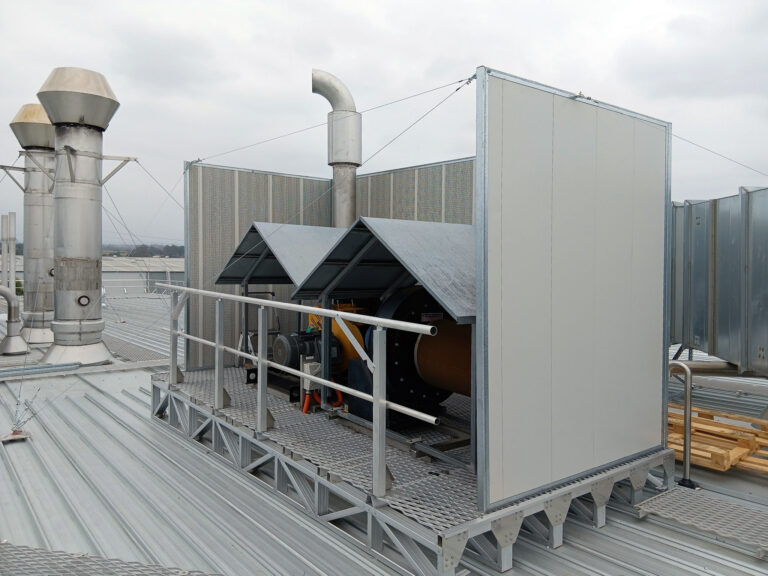
When an acoustic louvre is the right choice and when it is not
An acoustic louvre is asked to do three incompatible things through the same aperture. It has to let air through, keep water out, and attenuate sound. Each of those improves at the expense of the… -
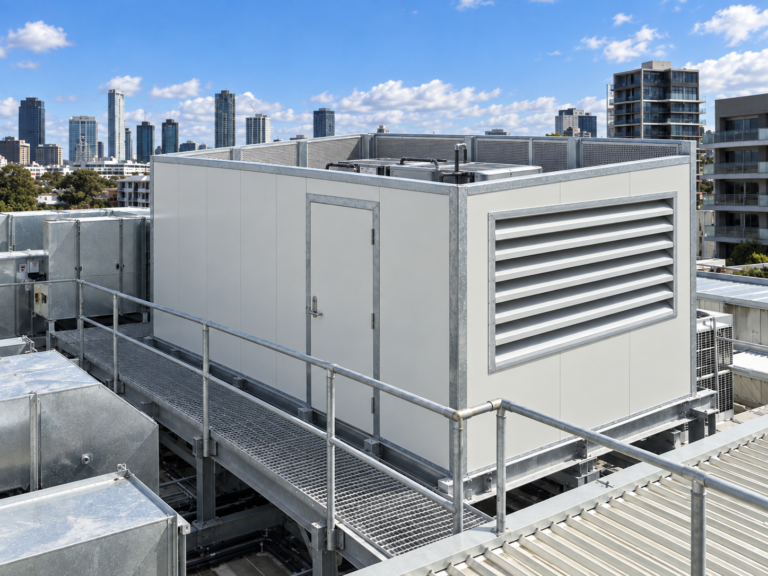
Insertion loss, transmission loss and Rw, choosing the right metric for the job
A mechanical engineer sizing a duct attenuator, an architect specifying a plantroom wall and a project manager reviewing a supplier submission can all be looking at a number followed by the letters dB and be… -
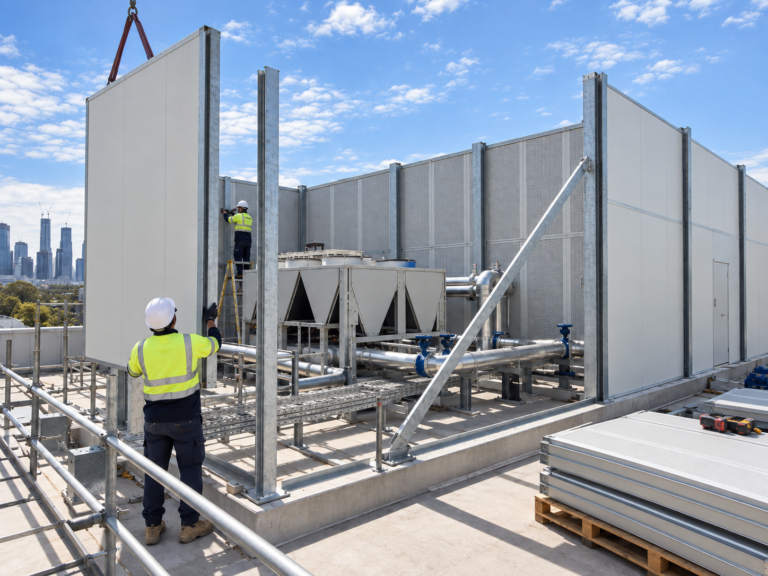
The acoustic specification brief, what consultants need from suppliers at tender stage
Three suppliers return prices against the same acoustic scope. The spread is forty per cent. Procurement reads that as a commercial finding, asks the lowest bidder to confirm compliance, receives a one line confirmation, and…