
What Australia’s data centre boom means for acoustic design before DA submission
In August 2026 the NSW Government published the NSW Data Centre Guidelines, which record around 60 data centres already operating in the state and 19 projects in the State Significant Development pipeline valued at $50.3 billion. The document also commits government to issuing Secretary’s Environmental Assessment Requirements within two months, and to completing the assessment…
In August 2026 the NSW Government published the NSW Data Centre Guidelines, which record around 60 data centres already operating in the state and 19 projects in the State Significant Development pipeline valued at $50.3 billion. The document also commits government to issuing Secretary’s Environmental Assessment Requirements within two months, and to completing the assessment process in no longer than 75 days while the application sits in state government hands.
For anyone working on the acoustic side of these projects, the volume is not the interesting part. The timetable is.
A faster assessment pathway moves acoustic risk earlier
Performance Measure 5 of the guidelines requires applicants to prepare a quantitative noise and vibration impact assessment covering construction and operation, carried out by a suitably qualified acoustic consultant in accordance with the relevant NSW Environment Protection Authority guidance and Australian Standards. That obligation is not new in substance. What has changed is how much time exists around it.
A compressed assessment window removes the informal buffer that acoustic design has historically relied on. On slower pathways, an assessment that returned a marginal result could be resolved during the assessment period. Plant could be relocated, a chiller model substituted, a screen height revised, and the amended package submitted before determination. When the state-side clock is capped, that iteration has to happen before lodgement or not at all.
The consequence is straightforward. The acoustic outcome of a data centre is largely determined by decisions made during site selection, massing, cooling architecture and equipment selection. The development application does not create those decisions. It documents them. Where those decisions were made without acoustic input, the assessment becomes a compliance test on a design that is already committed.
What the noise assessment actually rests on
An operational noise assessment for a data centre is built from three inputs, and the quality of each is fixed well before the report is written.
The first is receiver criteria. Under the NSW Noise Policy for Industry, the project noise trigger level is the more stringent of the project intrusiveness noise level and the project amenity noise level. The intrusiveness level is the rating background level plus 5dB. The policy sets minimum assumed rating background levels of 35dB(A) during the day and 30dB(A) in the evening and at night, which produce minimum project intrusiveness noise levels of 40dB(A) during the day and 35dB(A) in the evening and at night. The project amenity noise level for an industrial development is the recommended amenity noise level for the area type reduced by 5dB(A), which accounts for cumulative industrial noise. A rural or low background site can therefore carry a night-time trigger of 35dB(A), and that number is a property of the site, not of the design.
The second is source data. Predicted levels are only as sound as the sound power data behind them, and octave band data matters more than a single A-weighted figure once barriers, ground effects and air absorption are applied over distance. A headline dB(A) value tells a model very little about how the source will behave at 63 Hz or 125 Hz.
The third is geometry. Source height, receiver height, screening, reflecting surfaces and separation distance are all set by the architectural and structural packages. By the time a mechanical layout has been coordinated with structure, fire and electrical, the acoustic geometry is close to final.
None of these three inputs improves during assessment. They can only be established earlier.
Noise requirements are not uniform across Australia
Data centre developers working across several states should not assume that a design that satisfies one framework transfers cleanly to another.
New South Wales applies the Noise Policy for Industry, with modifying factor corrections for annoying noise characteristics. Victoria assesses noise from commercial, industrial and trade premises under the noise limit and assessment protocol, EPA Publication 1826.4, which sits under the Environment Protection Act 2017 and the Environment Protection Regulations 2021. Queensland works from the Environmental Protection (Noise) Policy 2019 and its acoustic quality objectives. Western Australia applies the Environmental Protection (Noise) Regulations 1997, which set assigned levels and apply their own adjustments.
The differences are not cosmetic. Research presented to the Australian Acoustical Society has shown that the level at which a tone is deemed to exist, and the penalty applied when it is, vary substantially between jurisdictions. In one comparison, more than 12dB separated the point at which a low frequency tone would attract a 5dB penalty in Western Australia from the point at which the same tone would attract one in New South Wales. Equipment that assesses acceptably in one state can require different treatment in another, and individual project approvals may impose conditions that sit tighter than the general framework.
Efficiency targets and cooling architecture pull against one another
The NSW guidelines set design PUE and design WUE targets that applicants are expected to meet. Performance Measure 1 asks for a design PUE at or below 1.25 with a design WUE at or below 1.0 on potable water or 1.6 on non-potable, or a design PUE at or below 1.3 with a design WUE at or below 0.44. Both ratios describe how much energy and water a facility consumes for every unit delivered to the IT load. Those targets shape the mechanical concept, and the mechanical concept shapes the noise.
Constraining water consumption tends to push heat rejection away from evaporative equipment and toward air cooled chillers and dry coolers. Air cooled heat rejection moves the acoustic burden to large arrays of axial condenser fans, which are numerous, elevated and often unscreened. Pushing design PUE down tends to favour economisation and higher air volumes, which increases the size of intake and discharge paths.
Neither outcome makes a site non-compliant. Both change the shape of the acoustic problem, and both are settled at concept design rather than at detailed design. An acoustic input at the point where the cooling architecture is chosen is worth considerably more than an acoustic report written after it is fixed.
Standby generators carry two sets of constraints at once
Performance Measure 4 of the NSW guidelines requires data centre diesel generators to demonstrate ambient air health-based criteria and to meet NSW Clean Air Regulation Group 6 air pollutant limits for stationary reciprocating internal combustion engines. Emissions control changes the exhaust arrangement, and the exhaust arrangement has a finite pressure budget.
Engine manufacturers publish a maximum allowable exhaust back pressure. Aftertreatment consumes part of that budget. Exhaust attenuation consumes more. Where both are required, the two have to be sized together against the same limit, and a silencer selected in isolation late in the process can be difficult to accommodate.
Generator testing is the second constraint. Standby plant is exercised on a routine cycle, and testing regimes are frequently written into approval conditions. The acoustic question is not only what the generators do during an outage. It is what a scheduled test does at a residential receiver on a weekday morning, how many units run simultaneously, and whether load bank testing sits inside or outside the assessed scenario.
Ventilation openings consume more façade area than teams expect
Every acoustically treated ventilation opening is larger than the free area the mechanical design requires, and the multiplier is a published property of the louvre.
Across the Sonic Series acoustic louvre models with published datasheets, AcousTech free area figures run from 21 per cent for the 200mm single blade SL4-20 up to 35 per cent for the deeper 300mm, 450mm and 600mm models. A 300mm chevron blade SL4-30C at 35 per cent free area needs a gross opening close to three times the net free area demanded by the airflow. The corresponding published Rw values run from 18dB for the 100mm SL4-10 to 33dB for the 600mm SL4-60, assessed to AS 1191-2002 and rated to AS/NZS ISO 717.1.
Two points follow. The first is dimensional. A 600mm deep louvre bank is a façade build up, a structural support condition and a maintenance access consideration, not a line item on a schedule. The second is metric discipline. Rw is a single number rating derived from transmission loss data. It is a useful way to compare products. It is not octave band insertion loss, and it should not be substituted for octave band data when a model needs to resolve low frequency fan energy. Ask for the frequency data before the opening size is committed.
The same logic applies to duct borne paths. Attenuator length, cross section and pressure drop have to be reconciled with the plantroom envelope and the fan selection, which is why balancing pressure drop against acoustic performance is a mechanical decision as much as an acoustic one.
Reserving space is the cheapest acoustic decision available
The most useful contribution acoustics can make before lodgement is often spatial rather than numerical. Depth for louvre banks and attenuators. Height and structural allowance for screening. Clear zones around plant so an enclosure can be built without blocking maintenance access or heat rejection. Access provisions that do not compromise the envelope, which is where rated doorsets such as the Sonic Access acoustic doors and modular construction such as the Sonic System acoustic modular panels become relevant.
Reserving that space costs very little at concept design. Recovering it after the structural grid, façade and plant layout are coordinated is a different exercise, and the cost of late stage acoustic changes on large projects is well documented.
The application tests the design rather than developing it
Faster planning pathways are a reasonable response to demand. They do not make acoustic assessment easier. They shorten the period in which an unsatisfactory result can be corrected, which pushes the real acoustic work back into concept design where it belongs.
The practical takeaway for project teams is a question of sequencing. Before a development application is lodged, a team should already know the receiver criteria that apply to the site, the octave band sound power data for the principal heat rejection and generator plant, the scenarios that will be assessed including generator testing, and the physical space the treatment will occupy. If those four items are settled, the assessment documents a design. If they are not, the assessment discovers one, and the timetable no longer allows for that.
Related Stories
-
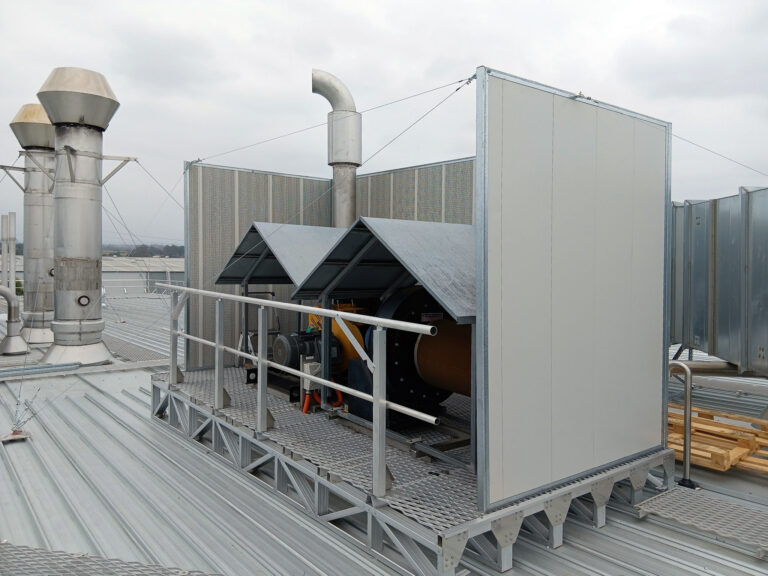
When an acoustic louvre is the right choice and when it is not
An acoustic louvre is asked to do three incompatible things through the same aperture. It has to let air through, keep water out, and attenuate sound. Each of those improves at the expense of the… -
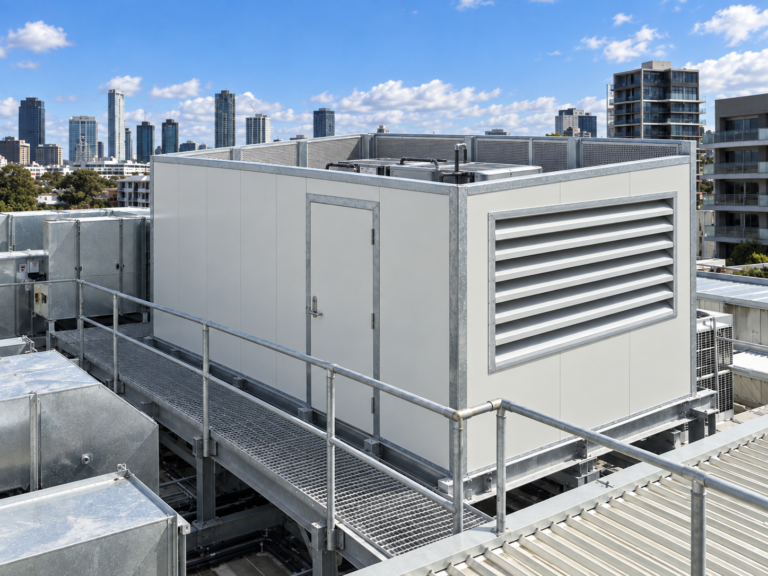
Insertion loss, transmission loss and Rw, choosing the right metric for the job
A mechanical engineer sizing a duct attenuator, an architect specifying a plantroom wall and a project manager reviewing a supplier submission can all be looking at a number followed by the letters dB and be… -
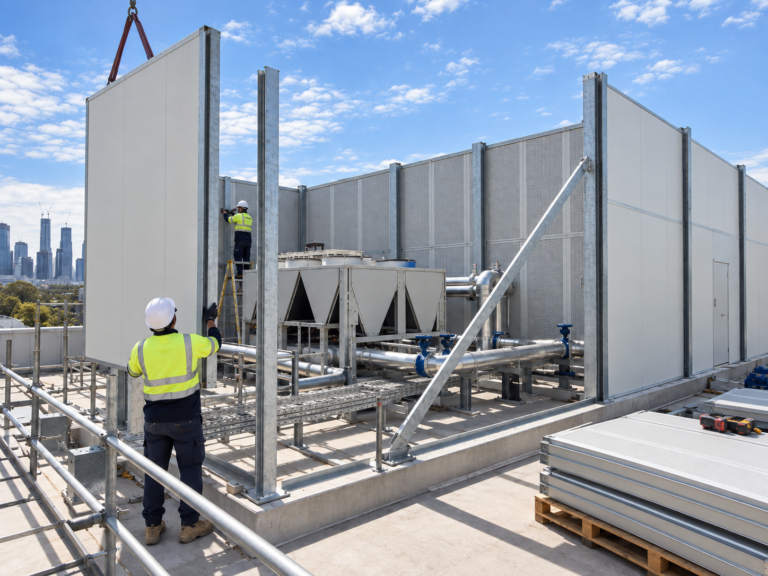
The acoustic specification brief, what consultants need from suppliers at tender stage
Three suppliers return prices against the same acoustic scope. The spread is forty per cent. Procurement reads that as a commercial finding, asks the lowest bidder to confirm compliance, receives a one line confirmation, and…