
Designing attenuation for performance below 125 Hz
Low-frequency noise below 125 Hz presents engineering challenges that standard attenuation approaches are not designed to address. While mid-to-high-frequency performance is relatively straightforward to achieve with conventional splitter attenuators, performance in the octave bands at 63 Hz and 125 Hz is often inadequate when standard products are specified without careful consideration of the underlying physics….
Low-frequency noise below 125 Hz presents engineering challenges that standard attenuation approaches are not designed to address. While mid-to-high-frequency performance is relatively straightforward to achieve with conventional splitter attenuators, performance in the octave bands at 63 Hz and 125 Hz is often inadequate when standard products are specified without careful consideration of the underlying physics.
The problem is well understood in theory but routinely underestimated in practice. Engineers specifying attenuation for fan systems, air handling units, or industrial exhausts often rely on catalogue data showing strong mid-frequency insertion loss. Below 250 Hz, that performance can fall away sharply, and a system that appears well-specified on paper can deliver strong insertion loss at 500 Hz while contributing little at 63 or 125 Hz.
This shortfall matters because low-frequency noise from HVAC and industrial plant is often the dominant component of receiver impact. It transmits readily through lightweight building envelopes, travels over long distances with minimal excess attenuation, and is perceived by building occupants as a persistent, low-level intrusion that standard A-weighted metrics do not fully capture. It is also the component most likely to generate complaints that are difficult to resolve after construction.
The physics of low-frequency attenuation
Absorptive attenuators convert acoustic energy into heat through interaction with porous fibrous or foam media. The efficiency of this process depends on the relationship between the acoustic wavelength and the physical dimensions of the attenuating element.
At 500 Hz, the acoustic wavelength in air is approximately 690mm. A 150mm thick splitter represents a substantial fraction of that wavelength, and energy absorption is efficient. At 125 Hz, the wavelength extends to around 2.7 metres. At 63 Hz, it approaches 5.4 metres. Against these dimensions, a 150mm splitter is acoustically thin, and interaction between the propagating wave and the absorptive medium is inherently weak.
The practical consequence is that standard silencer products, optimised to deliver strong performance in the 250 Hz to 2000 Hz range, can provide as little as 3 to 8dB of insertion loss in the 63 Hz octave band. Specified insertion loss at 500 Hz may be five to ten times higher. For systems where low-frequency energy is the primary design challenge, this is a performance gap that no amount of careful mid-frequency specification will close.
Achieving useful low-frequency attenuation requires a different approach. Greater splitter depth, longer attenuator sections, and higher-density absorptive media all contribute. In purpose-designed low-frequency products, splitter depths of 200 to 300mm and active lengths of 2 to 4 metres may be necessary to achieve useful insertion loss in the 63 and 125 Hz octave bands. Even with these measures, physical constraints are real: an insertion loss of 8 to 15dB in the 63 Hz band is a strong outcome for an absorptive design.
Reactive attenuation elements
Where absorptive designs cannot meet the target, or where space constraints limit splitter length and depth, reactive attenuation elements can supplement or replace conventional media-based approaches.
Expansion chambers create an impedance discontinuity in the duct, causing acoustic energy to be reflected back toward the source. Insertion loss depends on the expansion ratio and chamber length, and performance is frequency-selective rather than broadband. A well-designed chamber can achieve 10 to 20dB of attenuation at a target frequency, but contributes little outside its design range.
Quarter-wave resonators and Helmholtz resonators offer similarly targeted performance. These tuned devices are highly effective at the frequencies for which they are configured, but they are sensitive to manufacturing tolerances and may lose effectiveness if the source frequency shifts, for example across a variable-speed fan operating over a wide speed range.
In practice, the most effective low-frequency attenuation designs combine absorptive and reactive elements, targeting the dominant octave bands of the source noise spectrum while relying on the absorptive component for broader mid-frequency performance. The design process must begin with a detailed octave band characterisation of the source, not a single overall sound power level.
Prediction limitations and the case for measurement
Standard propagation prediction methods, including ISO 9613-2, apply frequency-dependent excess attenuation terms that can underestimate the transmission efficiency of low-frequency energy under real conditions. The standard was developed primarily for mid- to high-frequency assessment, and its reliability in the sub-125 Hz range is acknowledged to be limited, particularly over long propagation distances or where terrain and building geometry introduce complexity.
Manufacturer insertion-loss data for attenuators are typically derived from laboratory measurements under controlled conditions of uniform flow and standard duct geometry. An attenuator installed immediately downstream of a fan, at a duct bend, or within a complex plant room where airflow is turbulent and non-uniform may perform differently from the laboratory characterisation. Low-frequency insertion loss is particularly sensitive to these installation effects.
For projects where low-frequency performance is a determining factor in achieving compliance, reliance on modelled data alone carries real risk. Conservative design margins, with an additional 3 to 5dB allowed at the target octave bands, are prudent where space and cost permit. Post-installation measurement, conducted with the facility operating at representative duty, is the only reliable means of confirming whether design targets have been achieved.
Application to design decisions
The practical implication for engineers is that specifying attenuator performance by overall dB(A) insertion loss is insufficient for sources with significant low-frequency content. Octave band sound power data for the source, octave band insertion loss data for the attenuator, and frequency-specific propagation analysis should be reviewed in full, with particular attention to the 63 and 125 Hz octave bands.
Where fan selection remains within scope, fan type, rotational speed, and blade pass frequency all influence low-frequency output and should be considered alongside acoustic performance from the earliest stages of design. Axial fans operating at high tip speeds tend to generate more pronounced low-frequency tonal content than centrifugal fans at equivalent duty. Coordinating fan selection with the acoustic consultant before equipment procurement keeps options open that would otherwise be foreclosed.
Space allocation for attenuation is another early-stage consideration. Achieving adequate low-frequency performance typically requires greater physical length than standard products deliver. Plant room layouts developed without acoustic input frequently leave insufficient clearance for the attenuator depths and lengths needed to meet low-frequency targets. Acoustic input at the spatial planning stage, rather than at fitout, produces better outcomes at lower cost.
Low-frequency noise control below 125 Hz requires a different engineering approach to the absorptive mid-frequency attenuation that underlies most standard silencer products. The physics of wavelength and media interaction at low frequencies means that performance shortfalls are predictable, but they are not inevitable if the design process accounts for them from the outset. Achieving compliant outcomes depends on octave band assessment, appropriate product selection and configuration, realistic margins around modelled predictions, and an honest evaluation of what post-installation measurement will be needed to confirm performance.
For applications with defined low-frequency performance requirements, AcousTech’s Sonic acoustic attenuators can be configured to target specific octave band insertion loss values, including detailed low-frequency optimisation where standard catalogue selections would not provide adequate performance.
Talk to the AcousTech team about your project.
Related Stories
-
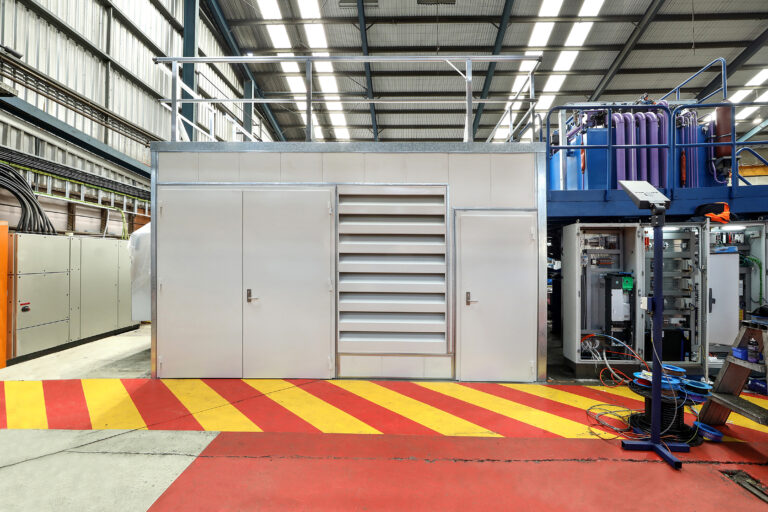
Designing generator intake and discharge paths without creating an acoustic weak point
A generator enclosure is an unusual acoustic object. Almost every other enclosure on a project is trying to be closed. This one has to move an enormous volume of air through itself continuously while the… -
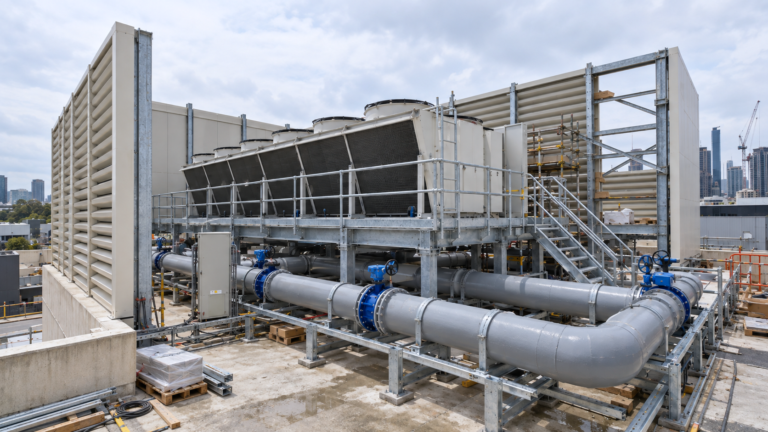
Why rooftop plant changes the noise risk for data centres
Putting heat rejection plant on the roof is usually a sound decision. It frees ground level area for electrical infrastructure and access, it shortens pipe runs, it keeps plant away from vehicle movements, and on… -
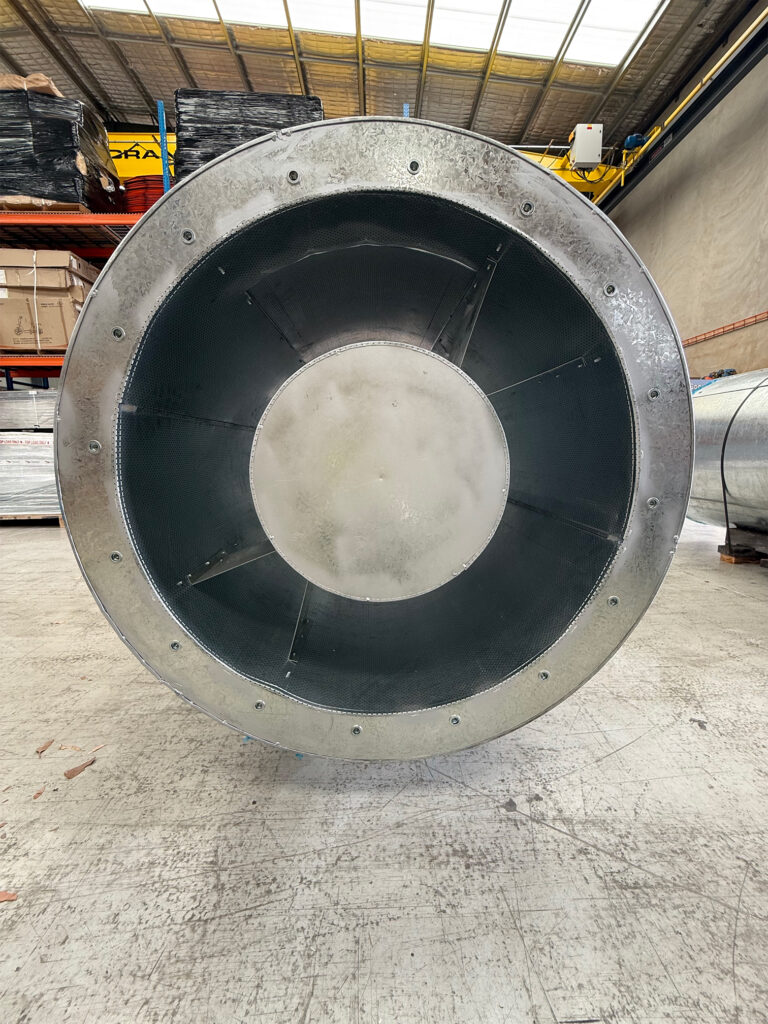
Why tonality in modern mechanical plant is becoming a project risk
Tonal noise from mechanical plant is not a new engineering problem. It has been present in HVAC and industrial equipment for as long as rotating machinery has been used to move air and fluid. What…