A NATA-accredited test report is one of the strongest pieces of evidence in acoustic testing and specification, and one of the most often misread. Accreditation confirms something specific about the laboratory that produced the result. Knowing exactly what it covers, and what still depends on the installation, is how a specifier gets full value from it.
NATA accreditation covers a laboratory’s competence within a scope
The National Association of Testing Authorities is Australia’s recognised accreditation body for testing, inspection and calibration facilities. Accreditation formally recognises that a laboratory has been assessed and found competent to carry out specific tests to specific standards, within a defined scope.
A facility is accredited for particular test methods, not as a general laboratory whose every activity carries the same status. For acoustic testing, that means accreditation speaks to the competence of the laboratory and the validity of its process for the tests within scope. NATA doesn’t design, manufacture or endorse the products tested.
Each accredited laboratory holds a published scope of accreditation listing the methods and standards it’s accredited for. A specifier who wants to confirm a test was carried out within that scope, and not by the same laboratory working outside it, can check the published scope against the standard cited in the report. It’s a useful step on high-value or life-safety specifications, and it doesn’t require taking the supplier’s description of the test on trust.
What a test report contains
A report from an accredited laboratory states the product tested, including its dimensions, construction and materials; the test method and standard; the mounting and boundary conditions; and the results. Those are usually frequency-band results across the octave or third-octave bands relevant to the test, with any single-number rating derived from them, such as an Rw calculated to AS/NZS ISO 717.1.
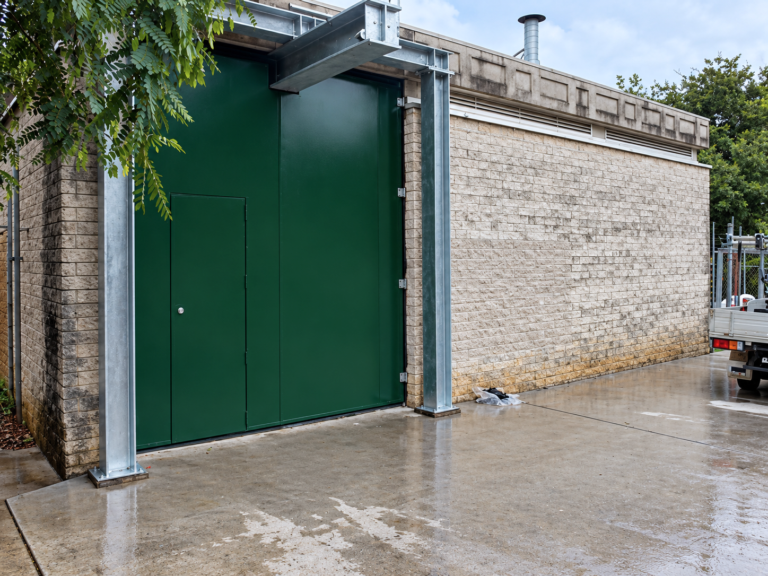
Our Sonic Access acoustic doors, for example, have been through NATA-accredited laboratory testing to AS 1191-2002, with Rw determined to AS/NZS ISO 717.1. The full reports are available on request.
Read the frequency data behind the single number
Two products with the same Rw can perform quite differently at specific frequencies, because Rw is a single-number summary calculated by comparing a measured frequency-band curve against a standard reference curve. For a source with a strong low-frequency or tonal component, the band data is often more informative than the headline figure. It shows performance at the frequencies that matter for that source, where the Rw is weighted to a generic reference curve. Specifiers dealing with tonal or low-frequency sources should request and review the band data behind the rating.
Single-leaf and double-leaf doors carry their own ratings
Sonic Access single-leaf and double-leaf doors are tested and rated separately, at Rw 46dB and Rw 45dB, because a double-leaf door adds a meeting stile and seal interface. Both ratings are published, so specify against the one that matches the door being installed.
What accreditation doesn’t tell a specifier
Accreditation doesn’t confirm how a product will perform once installed in a building or enclosure, because field performance depends on junction detailing, flanking paths and installation quality, all outside the scope of the laboratory test. And it doesn’t mean NATA has reviewed or endorsed the product, since NATA’s role is to accredit the laboratory and its processes.
None of this makes accredited data less valuable. It means reading the data for what it demonstrates, and putting the same care into the junctions as into the product selection.
Read the data, then detail the junctions
A NATA-accredited test report is reliable evidence of what a product achieved in a competent laboratory. Read the band data behind the single number where the source warrants it, then detail and seal the junctions around the product on site, because that is what decides how much of the tested performance the installation keeps.