
Australia wants more data centres. The grid wants something else.
Australia is commissioning data centres at a pace the grid was not designed to handle. The demand side is clear. Hyperscale operators, sovereign cloud programs, AI infrastructure investment, and federal policy settings are all pointing in the same direction. More facilities. Larger facilities. Faster. The supply side is a different conversation. Connection queues at major…
Australia is commissioning data centres at a pace the grid was not designed to handle. The demand side is clear. Hyperscale operators, sovereign cloud programs, AI infrastructure investment, and federal policy settings are all pointing in the same direction. More facilities. Larger facilities. Faster.
The supply side is a different conversation.
Connection queues at major transmission nodes have grown considerably. In some corridors, the wait time for a confirmed grid connection has stretched to several years. The Australian Energy Market Operator has been consistent in its guidance. The network is under pressure, and that pressure will continue through at least the mid-2030s. For data centre developers banking on co-location with existing infrastructure, the arithmetic often does not work.
This is changing site selection in ways the industry is still adjusting to.
Historically, a data centre site was chosen on the basis of land cost, fibre access, proximity to population centres, and cooling options. Grid capacity was a consideration, but rarely the determining factor. That has changed. Projects without a credible connection pathway, whether through direct negotiation with the network operator, a co-located generation arrangement, or a long-term renewable energy agreement, are not viable. The development pipeline has bifurcated. Operators with secured energy positions are progressing. Those without are waiting or reconsidering locations.
The geographic consequences are real. Parts of regional New South Wales, Queensland, and Western Australia are attracting data centre interest specifically because they offer viable grid access and land availability that metropolitan corridors cannot provide. That shift carries its own infrastructure and planning implications.
Planning frameworks are still catching up
Data centres do not fit neatly into most Australian planning instruments. They sit in an ambiguous position, not industrial in the traditional sense, not commercial in the way most frameworks anticipate, but requiring large footprints, dedicated infrastructure corridors, and connections that affect network planning at a regional level.
The practical result is that project teams are navigating pathways designed for other uses. Conditions are applied inconsistently. Referral triggers vary between jurisdictions. Environmental impact categories are not always clear. For developers working across multiple states, this means separate planning strategies for each project, which adds time and cost that project programs rarely account for at feasibility.
Noise sits at the intersection of planning risk and technical design.
The acoustic problem is structural, not incidental
A large data centre generates sustained mechanical noise. Cooling towers, chillers, backup generators, adiabatic cooling systems, and the uninterruptible power infrastructure required to maintain uptime in a high-density compute environment all produce continuous output across a broad frequency range. That output does not attenuate to negligible levels at the site boundary without deliberate acoustic design.
The planning problem is that data centres are increasingly being sited in corridors that include or adjoin residential land. Mixed-use industrial zones. Urban fringe precincts. Areas where planning authorities are applying specific, numeric noise conditions that must be demonstrated through assessment and confirmed through commissioning.
Sonic acoustic walls are one of the primary tools for managing that boundary condition. Barrier design needs to reflect the actual geometry of the site, the dominant noise sources, and the frequency characteristics of the mechanical plant. That last point matters more than most project teams expect. A barrier that performs well across mid-range frequencies may not provide adequate attenuation at the lower frequencies that characterise large generators and cooling plant. Getting this right requires modelling, not assumption. AcousTech’s data centre acoustics experience covers both the modelling and the treatment specification.
The projects managing this well are doing the acoustic work in the design phase, not after construction. Compliance with planning conditions is determined at approval. The scope of acoustic treatment required is largely fixed by the mechanical plant that goes into the facility. Once those selections are made, the options narrow considerably.
What this means for data centre delivery teams
Data centre delivery in Australia is now an exercise in constraint management. Grid access, planning pathway, environmental compliance, and acoustic performance all need to be addressed in sequence, starting well before a project reaches detailed design.
The projects that are moving efficiently are the ones that scoped these constraints early. They engaged with network operators before finalising site selection. They understood the planning framework before committing to a pathway. They ran acoustic assessments alongside mechanical design, not after it.
Australia’s digital infrastructure pipeline is deep and growing. The drivers are not going away. But the projects that will progress without disruption are the ones designed around the constraints that exist, rather than the frictionless process that does not.
The grid is not getting faster. The planning frameworks are not getting simpler. Infrastructure that supports Australia’s digital economy needs to be designed with all of that in mind from day one.
Related Stories
-
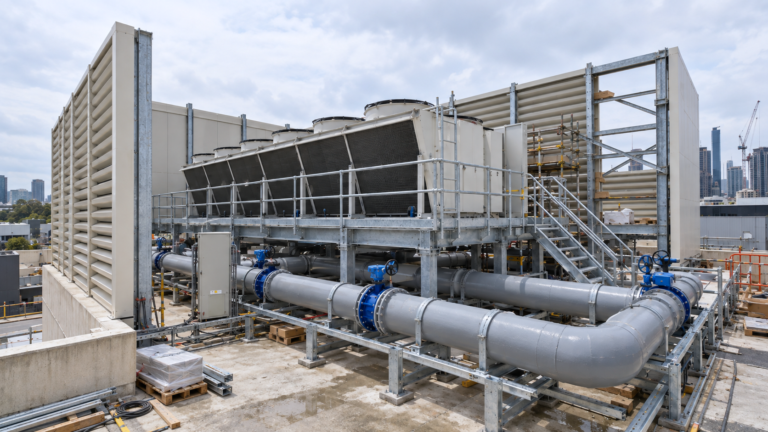
Why rooftop plant changes the noise risk for data centres
Putting heat rejection plant on the roof is usually a sound decision. It frees ground level area for electrical infrastructure and access, it shortens pipe runs, it keeps plant away from vehicle movements, and on… -
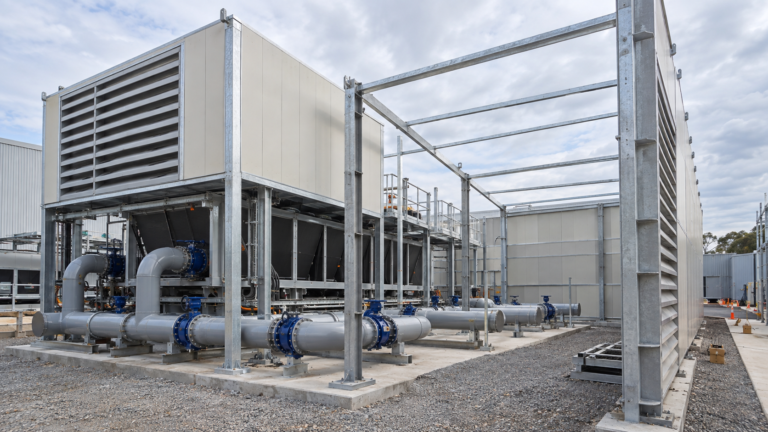
Acoustic headroom, the design allowance that protects future data centre expansion
Data centre projects reserve capacity as a matter of course. Electrical infrastructure is sized with spare feeder capacity. Cooling is designed with redundancy and a growth path. Structure is built for a future deck. Land… -
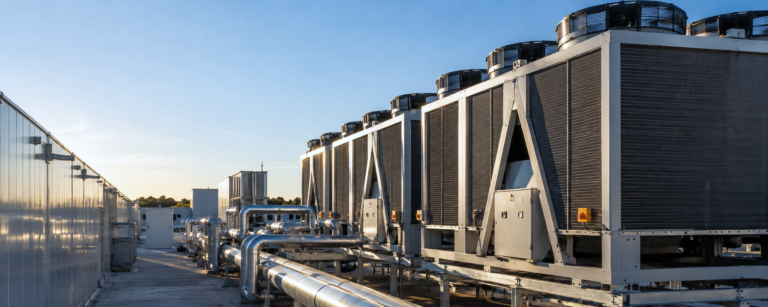
Data centre noise 101 for project teams, where the noise actually comes from
Most data centre noise summaries are written as a list of equipment. Chillers, cooling towers, fans, transformers, generators. The list is accurate and not especially useful, because it does not tell a project team which…