The power conversation has dominated infrastructure planning for two years. Grid capacity, connection timelines, and energy procurement have become real programme constraints across the sector. Most of the attention in project feasibility is going to those problems.
On site, the bottleneck is showing up somewhere else.
The projects running into trouble are not always running into trouble because of power. They are running into trouble because the interface between mechanical plant and the built structure that contains it is not being resolved early enough. On data centre builds, on processing facilities, on any project that runs continuous mechanical load at scale, this is where delay is accumulating.
Louvre specification and the facade coordination problem
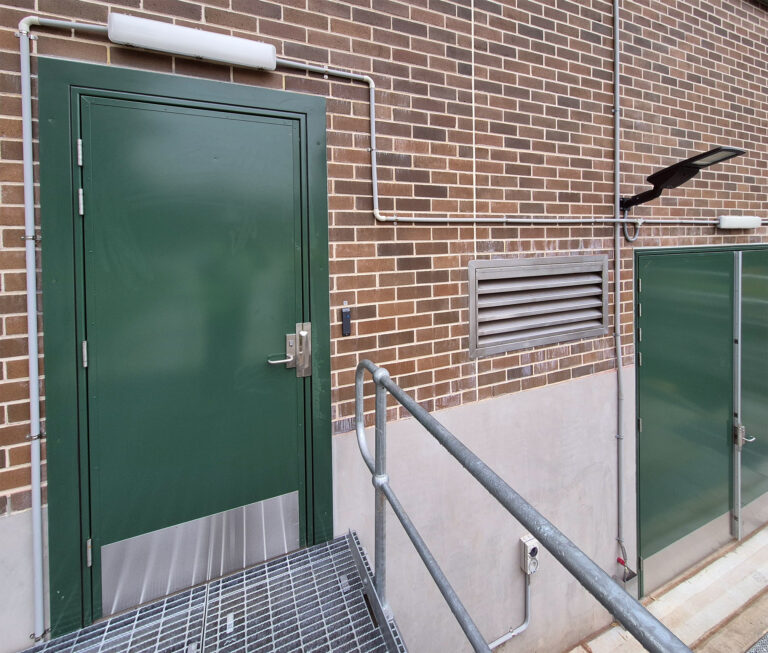
Plant rooms ventilate through the building envelope. The louvres in that facade carry two requirements at once. They need to move enough air to keep the plant running. They also need to perform acoustically at the site boundary. Those two requirements do not always align. Resolving the conflict is a design task. It needs to happen before the facade is installed.
On projects where this gets left to construction stage, the options narrow. A louvre installed to meet a ventilation specification may not deliver the acoustic attenuation the planning condition requires. Replacing it means cutting into a finished facade. That is programme delay and variation cost that is entirely avoidable.
The Sonic Series acoustic louvres are designed to manage both requirements simultaneously. The blade configurations differ in how they balance free area against acoustic performance. Selecting the right configuration requires knowing the noise source, the frequency range of the plant, and the attenuation required at the boundary. That analysis needs to be done at design stage in coordination with the mechanical engineer, before the facade package is finalised.
Procurement compounds the problem when specification is left late. Acoustic louvres built to a defined performance standard are not off-the-shelf products. Lead times are real. When the specification is confirmed after the construction programme has been set, the louvres arrive after the facade is ready for them. The result is a gap in the programme or installation sequencing that should not exist.
Acoustic enclosures and trade coordination on site
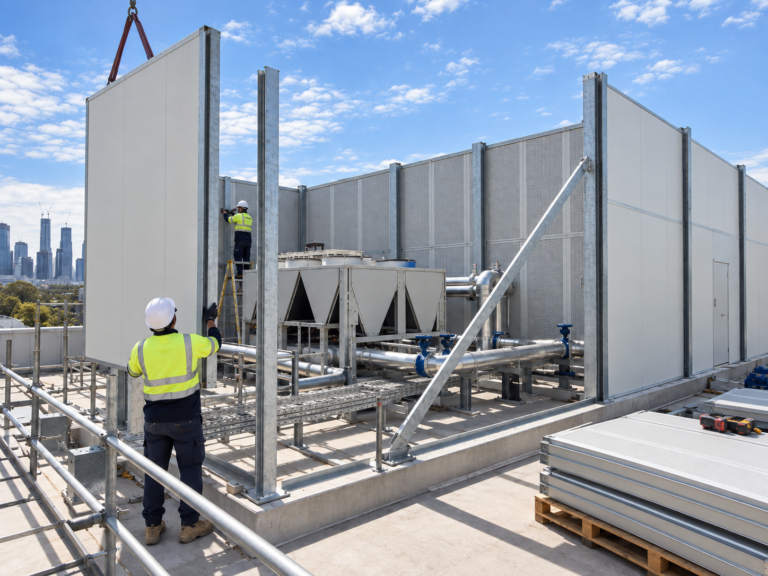
Mechanical plant that cannot be located inside the building structure ends up on the roof, on a plant podium, or in a yard adjacent to the facility. The acoustic performance of the enclosure around that plant determines whether the facility can operate within its compliance conditions. This is not complicated, but it is frequently treated as a late-stage task.
Sonic acoustic enclosures require coordination across trades. The mechanical contractor, the structural contractor, and the acoustic contractor all have work that intersects. When the enclosure is left to the tail end of the construction programme, that coordination does not happen in the right order. Panels are installed to a structural specification that does not account for acoustic sealing. Penetrations are cut that compromise the performance of the assembly. The result is a commissioning test that fails a noise condition after practical completion.
At that point, the building is complete and the plant is running. The remediation options are constrained and none of them are cheap.
Why sequencing is the real acoustic risk
The pattern repeats across project types. Power and grid connection get managed early because everyone understands the stakes. Acoustic treatment gets managed late because the consequences are less visible until commissioning.
Getting acoustic design into the programme at the same point as mechanical and facade design changes the outcome. Lead times can be managed. Interface coordination can be planned. The specification of louvres and enclosures can be confirmed before procurement is locked in. None of that is difficult. It is a sequencing decision.
The same principle applies to procurement strategy. Acoustic products specified to performance requirements need to be ordered with enough lead time to arrive when they are needed on site. On a complex build, that means confirming the acoustic specification before the construction programme is baselined, not after.
Different project types are affected. Data centres, defence facilities, manufacturing plants, pumping stations, and utility infrastructure all involve mechanical plant that generates noise continuously. The acoustic treatment required varies. The sequencing principle does not.
The projects managing this well are treating acoustic design as a parallel discipline to mechanical and civil, not as a downstream task. They are resolving the louvre specification at the same time as the mechanical plant selection. They are planning the enclosure installation sequence before the structure goes up.
The infrastructure sector is managing a lot of competing priorities. The ones that create the most disruption are the ones that arrive late. Acoustic treatment does not have to be one of them.