How airflow and acoustic control can work together
When acoustic performance is considered early, design decisions become more deliberate.
Airflow paths are no longer just about moving volume; they become controlled interfaces. Every opening, junction and access point plays a role in how sound is either contained or transmitted.
For data centres and BESS facilities, this comes into focus across three key areas.
1) Air intake and discharge
These are often the most direct transmission paths for noise. Without treatment, they allow sound energy to pass through with minimal resistance.
Our approach
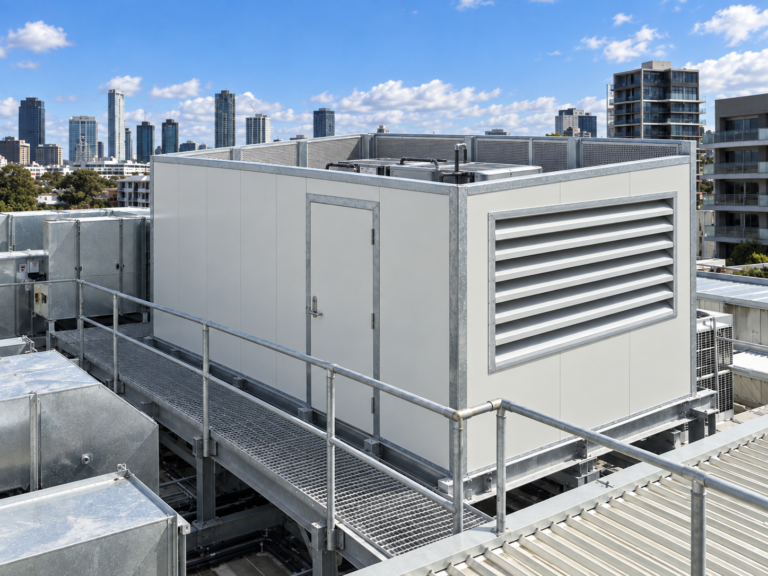
Sonic Series acoustic louvres balance airflow with sound reduction. The acoustic louvre for HVAC is designed to act as both a noise-reducing barrier and an efficient airflow pathway. When combined with HVAC acoustic screen walls, such as Sonic System acoustic modular panels, they support both performance and compliance.
2) Access points
Doors are a frequent weak point for noise. Standard constructions introduce gaps and low-mass surfaces that allow sound leakage.
Our approach
Sonic Access acoustic doors maintain enclosure integrity and operational functionality. Performance is defined by mass, sealing, and construction detail.
These doors work alongside HVAC noise reduction strategies such as acoustic louvres for HVAC and acoustic screen walls.
3) Enclosures and internal surfaces
Plant rooms and external compounds benefit from controlled internal conditions. Reducing reverberation limits the build-up of sound energy before it reaches boundaries.
Our approach
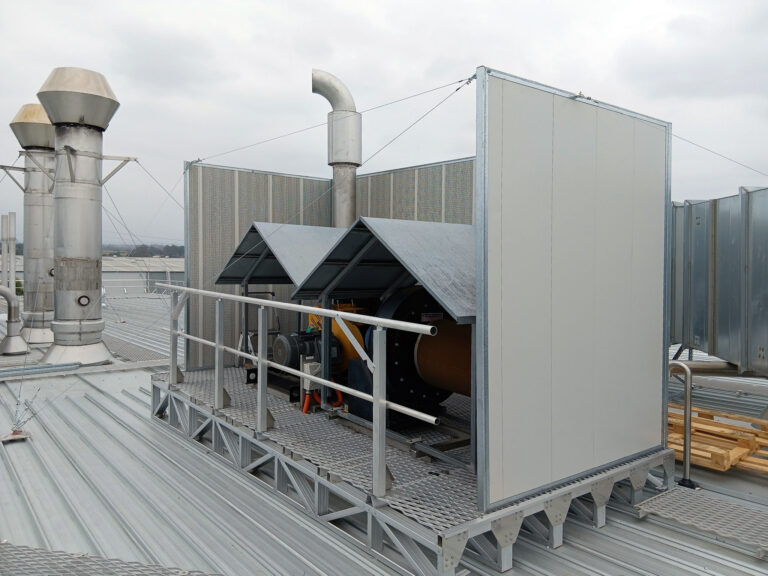
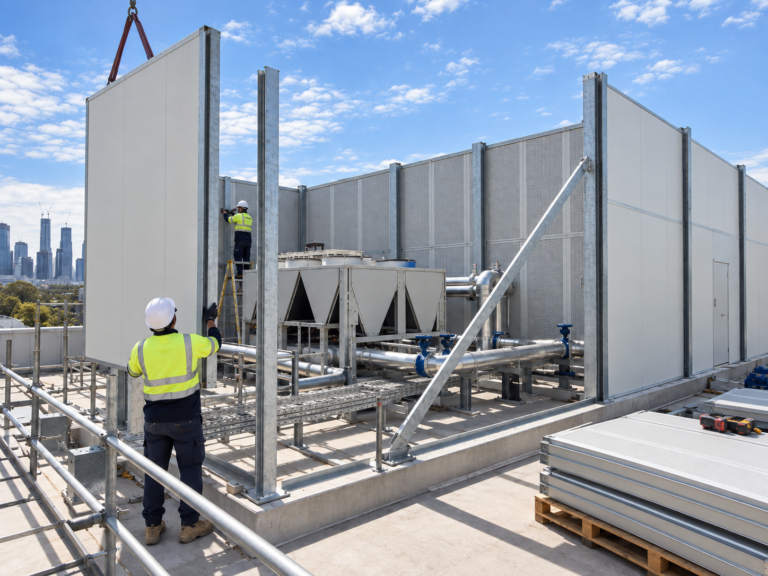
Sonic System acoustic modular panels are used as HVAC acoustic screen walls to line or construct enclosures for predictable noise reduction across facility types.
Integrating these panels with acoustic louvres for HVAC delivers reliable HVAC noise reduction for sensitive installations.
Need advice on HVAC acoustic screen walls?
When the three elements above are designed to work together, HVAC systems operate within an acoustic framework, supporting both performance and compliance. It’s a shift from reactive fixes to deliberate design.
To talk to the specialists at AcousTech, call 1300 508 232.
Trusted by engineers, built for performance.
The science of silence.