
Cumulative noise, what happens when every plant item meets its individual target
A specification requires that no individual item of plant exceed 45dB(A) at the nearest receiver. Eight items are installed. Every one is measured at commissioning and every one complies. The site is measured at 54dB(A). Nine decibels over, with no defective item and no supplier at fault. The failure was in the allocation, and it…
A specification requires that no individual item of plant exceed 45dB(A) at the nearest receiver. Eight items are installed. Every one is measured at commissioning and every one complies.
The site is measured at 54dB(A). Nine decibels over, with no defective item and no supplier at fault.
The failure was in the allocation, and it happened at specification stage. Every item was given the whole budget, and the budget was only ever available once.
Decibels do not add the way the notation suggests
The decibel is a logarithmic expression of a ratio, so two quantities expressed in decibels cannot be added arithmetically. What adds is the acoustic energy underneath them.
The combination of several levels is found by converting each back to its energy ratio, summing, and converting the total back.
Total level equals ten times the logarithm of the sum of the terms ten raised to the power of each individual level divided by ten.
The consequences follow directly, and they explain most of what happens on a multi source site.
|
Situation |
Result |
|
Two equal sources |
3.0dB above one of them |
|
Three equal sources |
4.8dB above one |
|
Four equal sources |
6.0dB above one |
|
Five equal sources |
7.0dB above one |
|
Eight equal sources |
9.0dB above one |
|
Ten equal sources |
10.0dB above one |
|
N equal sources |
10 log N above one |
Two sources at 50dB(A) produce 53.0dB(A). Four produce 56.0. Ten produce 60.0. Adding an identical machine costs three decibels the first time, and progressively less each time after that, because each addition is a smaller proportional increase in total energy.
How much a quieter source actually adds
The same relationship works in the opposite direction, and this is the part that decides where mitigation money should go.
A source 10dB below the dominant source adds about 0.4dB to the total. Fifty and forty combine to 50.4.
A source 6dB below the dominant source adds about 1dB. Fifty and forty four combine to 51.0.
A source 3dB below adds about 1.8dB. A source equal to it adds 3dB.
Two practical conclusions follow.
The first is that treating a source more than about 10 dB below the dominant contributor achieves essentially nothing at that receiver, however much it costs. Identifying the dominant contributors and treating those is the only sequence that produces measurable results.
The second is that the dominant source cannot be reduced below the level of the next contributor without also treating the next contributor. Take a dominant source at 50dB(A) and a second source at 45dB(A), combining to 51.2dB(A). Reducing the dominant source by 15dB, to 35dB(A), brings the total to 45.4dB(A). The site has gained 5.8dB, not 15, and the result now sits within half a decibel of the second source on its own. The rest of the plant is holding the level up.
Why an identical limit for every items fails
Setting the same maximum level on every plant item is intuitive, easy to write and easy to verify. It is also, in a strict reading, a method for guaranteeing exceedance whenever more than one item runs at once.
If the site criterion at a receiver is 45dB(A), and eight items each meet 45 dB(A) at that receiver, the total is 45 plus ten log eight, which is 54.0dB(A).
To have eight equal contributors combine to 45dB(A), each must be held at 45 minus ten log eight, which is approximately 36 dB(A). Nine decibels lower than the specification asked for, and nine decibels is the difference between a straightforward selection and a substantial mitigation package.
This is not a hypothetical construct. The NSW Noise Policy for Industry applies exactly this logic where several new premises are proposed within an industrial cluster, setting an individual project amenity noise level equal to ten times the logarithm of the amenity level energy divided by the number of proposed premises. The policy also requires that a project amenity noise level, five decibels below the recommended amenity level for the area, applies to each new source so that existing plus new industrial noise remains within the recommended level for the area.
The principle at plant item level inside a single site is the same principle at premises level inside a precinct.
No allocation method is universally correct
Equal allocation is one method among several, and its main virtue is that it is defensible and simple to administer.
Proportional allocation assigns more of the budget to sources that are inherently loud or expensive to treat, and less to sources that are quiet or easily attenuated. It produces cheaper outcomes and harder specifications to write and enforce.
Dominant source allocation gives the majority of the budget to the two or three items that will govern the result anyway, and sets the remainder low enough that they contribute negligibly. It is efficient and it fails badly if the plant schedule changes after allocation.
Practicability based allocation works backwards from what each item can realistically achieve with available treatment, which is the most honest approach and the most dependent on supplier data being available early.
Which method suits a project depends on how well the plant schedule is defined, how much of the plant is already selected, and how much programme remains. What does not vary is the requirement that the individual limits, whatever method produced them, sum to something at or below the criterion, at each receiver, under the operating case being assessed.
The three things that break an allocation after it is set
An allocation that was correct when written can stop being correct without anyone changing a number.
The first is that the assessed operating case changes. Plant that was assessed as never running simultaneously begins running simultaneously, whether because of a control change, a summer peak, a redundancy test or a commissioning activity. The allocation assumed a subset and the site now operates the full set.
The second is that the project grows. Where a site is staged, and the first stage is allocated the whole budget because it is the only stage that exists, the second stage arrives with nothing available. This is a recurring pattern on data centre campuses, battery storage sites, water treatment upgrades and industrial facilities with expansion approvals, and it converts a future capacity question into a retrofit problem on plant that is already installed and running.
Reserving headroom is the counter to this, and it costs something now. A 3 dB design allowance means the first stage is designed to half the energy of the criterion rather than all of it. That is a decision for the asset owner, not for the acoustic consultant, and it should be made explicitly rather than by default.
The third is that the receiver assumption changes. An allocation is receiver specific, because the contribution each item makes depends on its distance, its shielding and its directivity relative to that receiver. Plant on the northern boundary may dominate at the northern receiver and be irrelevant at the southern one. A single site wide allocation applied to every receiver is either wasteful at one and inadequate at another, and where a new dwelling is approved closer to the site, the whole allocation needs to be recalculated rather than adjusted.
Background level, and what the total is being compared with
Cumulative arithmetic determines the level the site produces. Whether that level complies depends on what it is compared with.
Where the criterion is derived from the background level, as intrusiveness criteria generally are, the comparison shifts with the measured background at that receiver, which varies by period and by season. Where the criterion is an absolute amenity level, it does not.
Two further points need separating. Combining the site total with the existing background to describe the resulting ambient level is a different calculation from comparing the site total against a criterion, and the two are sometimes conflated in reporting. And logarithmic addition of A-weighted levels is a summary operation. Where tonality, low frequency content or spectral shape matter, the addition should be performed band by band, because two sources that combine to the same overall level can produce very different spectra and attract different adjustments.
Where treatment belongs once the arithmetic is done
The value of the cumulative analysis is that it tells a project team where to spend.
Once the dominant contributors at each receiver are identified, treatment can be directed at those items specifically. Source treatment through an enclosure, screening through an acoustic wall between the source and the receiver, treatment of the openings through louvres, and in duct attenuation each address a different part of a particular source’s contribution, and each is worth applying only to sources whose contribution is large enough to matter.
Applying treatment evenly across a plant schedule, in the same way that a limit is sometimes applied evenly, produces the same result as an equal allocation. It looks thorough, it costs a great deal, and it moves the total by less than the invoice suggests it should.
Nothing in the cumulative problem is mathematically difficult. It fails in practice because an individual limit is a clean thing to write into a specification and a total budget is not.
The discipline is to work in the opposite order. Establish the criterion at each receiver, decide what design allowance is being reserved for future stages, allocate what remains across the plant that will operate simultaneously, and only then write the individual limits that fall out of that allocation. Where the allocation produces item limits that suppliers cannot meet, that is a finding about the layout or the plant selection, and it is available months before it would otherwise have surfaced.
An individual noise limit is only meaningful as a share of something. A specification that states the limit without stating what it is a share of has passed an arithmetic problem down the contract chain to the party least able to see the whole of it.
Related Stories
-
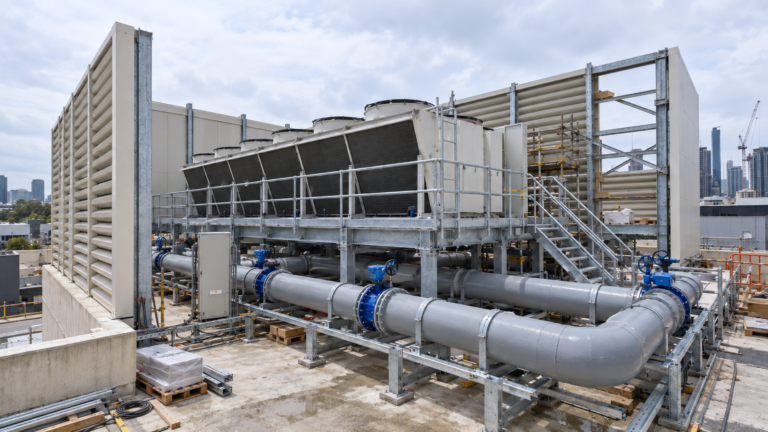
Why rooftop plant changes the noise risk for data centres
Putting heat rejection plant on the roof is usually a sound decision. It frees ground level area for electrical infrastructure and access, it shortens pipe runs, it keeps plant away from vehicle movements, and on… -
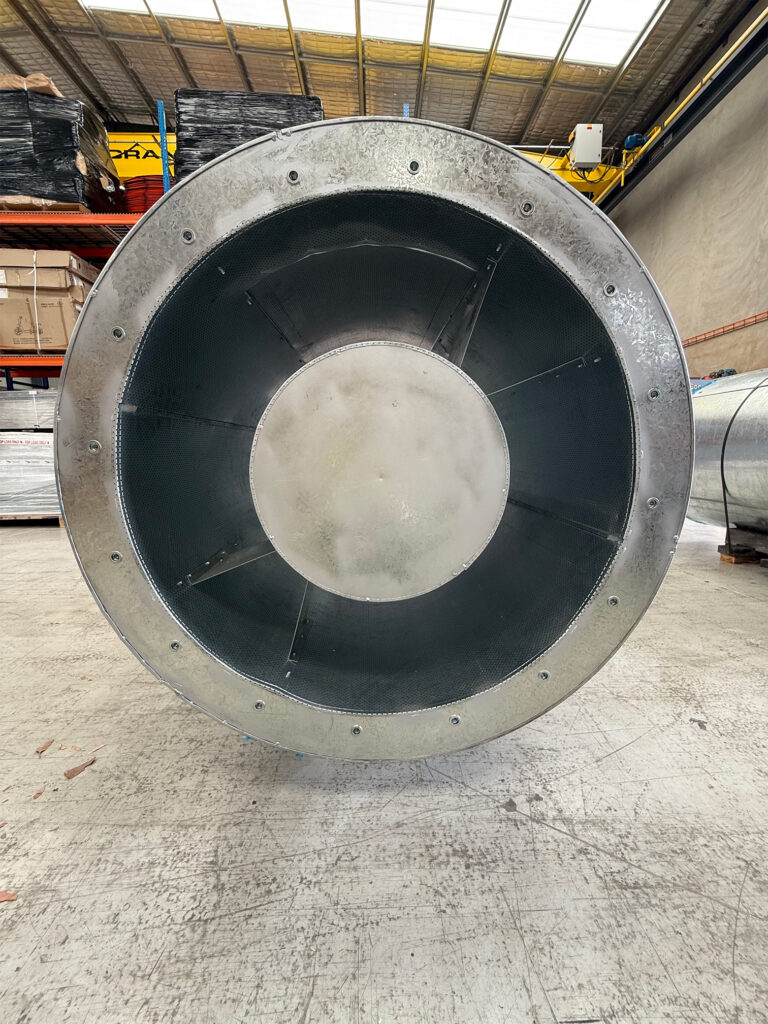
Why tonality in modern mechanical plant is becoming a project risk
Tonal noise from mechanical plant is not a new engineering problem. It has been present in HVAC and industrial equipment for as long as rotating machinery has been used to move air and fluid. What… -
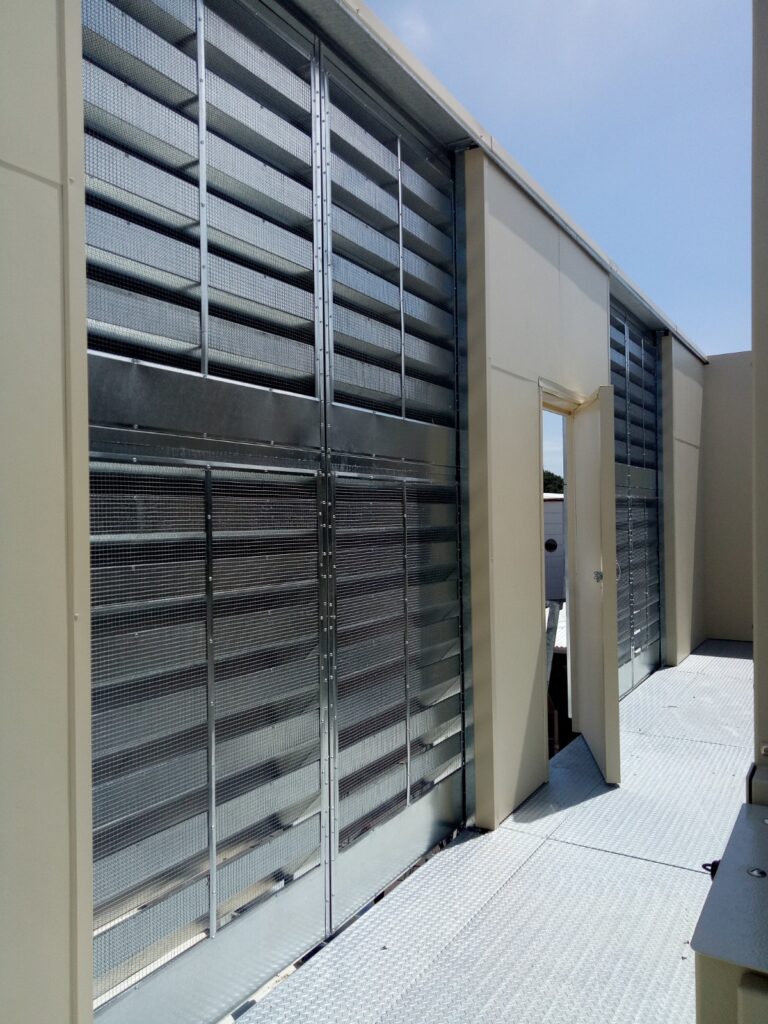
Cumulative noise impacts in clustered installations
Infrastructure and industrial development patterns have changed considerably in recent decades. Data centres that once occupied isolated suburban sites are now located in urban industrial precincts, often clustered with other continuous-operation facilities. Battery energy storage…