
Cumulative noise impacts in clustered installations
Infrastructure and industrial development patterns have changed considerably in recent decades. Data centres that once occupied isolated suburban sites are now located in urban industrial precincts, often clustered with other continuous-operation facilities. Battery energy storage systems (BESS) are constructed at scale alongside substations in areas that may be adjacent to residential zones. Mechanical services plant…
Infrastructure and industrial development patterns have changed considerably in recent decades. Data centres that once occupied isolated suburban sites are now located in urban industrial precincts, often clustered with other continuous-operation facilities. Battery energy storage systems (BESS) are constructed at scale alongside substations in areas that may be adjacent to residential zones. Mechanical services plant on commercial rooftops is denser than it was a generation ago, reflecting the intensification of building use and the proliferation of IT and cooling loads.
Each of these developments raises the same acoustic question more acutely than previous project types: what does the cumulative noise environment look like, and does the total impact remain acceptable even when individual sources comply with their own design criteria? This question is not hypothetical. Regulatory frameworks in most Australian states allow assessment bodies to consider cumulative impact, and community concern about noise from clustered developments is a frequent trigger for review of individual approvals that would otherwise have been uncontested.
The cumulative noise problem is a question of how multiple acoustic sources combine at a shared receiver, and how that combination should be characterised, predicted, and managed. The mathematics are well established; the engineering challenge lies in applying them in contexts where source data is often incomplete, operating scenarios are uncertain, and the relationship between individual and cumulative assessments is not always clearly defined in applicable frameworks.
The arithmetic of noise addition
Sound pressure levels are measured on a logarithmic scale, and the combination of multiple independent sources follows logarithmic addition rules rather than simple arithmetic. Two sources each producing 60dB at a receiver combine to produce approximately 63dB, not 120dB. Ten equal sources each at 60dB combine to produce 70dB. The practical implication is that adding sources to an existing noise environment produces diminishing increments of total level, but those increments do not become negligible.
For sources with similar sound power levels operating simultaneously, the cumulative level at a receiver is dominated by the group as a whole rather than any individual. A development that introduces three new sources each at 3dB below the criterion level will, in combination, produce a level that exceeds the criterion, even though each individual source complies. This is a straightforward arithmetic consequence that individual-source assessments do not capture.
The level of the pre-existing background acoustic environment matters in this context. Where background levels are already relatively high, the increment from a new clustered development may be small enough to be within acceptable limits even when multiple sources are combined. Where background levels are low, as in rural-adjacent or sensitive urban locations, the same cluster of sources may produce an increment that exceeds acceptable limits at receivers within its propagation range.
Temporal overlap and operating scenarios
Cumulative noise assessment is not only a question of spatial source combination; it also requires careful consideration of when sources operate and whether their operating periods overlap at the receiver. Sources that do not operate simultaneously do not combine at a receiver, and a worst-case assessment based on all sources operating at full load simultaneously may not represent a realistic scenario.
For BESS installations, cooling plant may operate continuously but at varying load depending on ambient temperature and battery charging state. For data centres, cooling loads are relatively stable but may vary with IT load. For industrial plant with multiple production lines, operating schedules may differ by shift or by product type. Characterising the realistic worst-case operating scenario requires understanding how the facility actually runs rather than assuming all sources operate simultaneously at peak output.
At the same time, conservative assumptions about simultaneous operation are often appropriate where operating schedules are not contractually fixed and may change over time. A facility that currently operates below design capacity will likely reach full capacity at some point, and cumulative assessment based on the current operating scenario may underestimate impact over the life of the development.
Spatial modelling of combined propagation
Where multiple sources are distributed across a site, their individual contributions to receiver noise levels depend on propagation distance and any screening effects of intervening terrain or structures. Sources on one side of a site may dominate at receivers to that side, while sources on the other side dominate at different receivers. Simple combination of source levels without accounting for spatial distribution and propagation geometry produces inaccurate results and can mask which sources are actually driving receiver levels.
Three-dimensional acoustic modelling software, using propagation algorithms consistent with ISO 9613-2 or more detailed methods where warranted, allows the individual and combined contributions of each source to be calculated at multiple receiver locations simultaneously. This approach identifies which sources dominate at each receiver, which operating scenarios produce the worst-case total, and where acoustic treatment would be most productive in reducing cumulative impact.
For complex industrial or infrastructure sites, the modelling effort required to characterise cumulative impact accurately is non-trivial. It requires confirmed sound power data for each source, spatial coordinates of each source and receiver, and accurate ground cover and barrier geometry. Data gaps in source characterisation produce uncertainty in cumulative predictions. Where confirmed data is not available, conservative assumptions or post-commissioning measurement are the appropriate response.
Acoustic treatment in a cumulative context
Identifying treatment priorities in a cumulative noise scenario requires a different analytical approach from a single-source situation. The source that contributes most to the cumulative receiver level is the highest-priority candidate for treatment, and that source may not be the one with the highest overall sound power on site.
For cooling plant associated with data centre or BESS installations, the dominant noise sources are typically the condenser fans and, where dry coolers are used, the forced-draft fans associated with heat rejection. These are broadband sources with pronounced low-frequency content, and their attenuation requires consideration of the full octave band spectrum rather than a single overall level target.
Acoustic louvres on air intake and discharge openings are a common treatment approach for outdoor plant enclosures, providing attenuation while preserving the aerodynamic free area required for cooling. Attenuators on forced-ventilation paths, acoustic barriers between plant and receiver, and enclosure treatments for high-intensity point sources each address specific components of the cumulative noise budget. The allocation of treatment between these elements should be driven by the source contribution analysis rather than applied uniformly. AcousTech’s Sonic Series acoustic louvres and Sonic acoustic attenuators are frequently applied in this context, with performance characteristics selected on the basis of octave band contribution analysis for specific receiver locations.
Cumulative noise assessment is not an extension of single-source assessment; it requires a different approach to source combinations, operating scenarios, and spatial propagation. The compliance of each individual source with its own design criterion provides no guarantee that the cumulative impact of a cluster of sources will remain within acceptable limits at shared receivers. Managing cumulative impact requires early-stage spatial modelling, realistic characterisation of operating scenarios, and acoustic treatment allocated to sources on the basis of their actual contribution to receiver levels. For developers and project engineers working in densely developed or sensitive locations, building this analysis into the design process from the outset is more productive than addressing it once community or regulatory concerns have already emerged.
Talk to the AcousTech team about your project
Related Stories
-
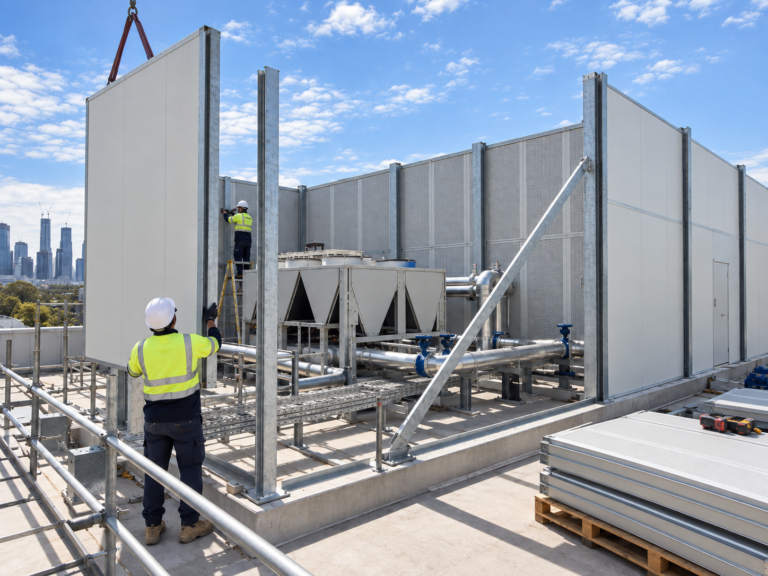
The acoustic specification brief, what consultants need from suppliers at tender stage
Three suppliers return prices against the same acoustic scope. The spread is forty per cent. Procurement reads that as a commercial finding, asks the lowest bidder to confirm compliance, receives a one line confirmation, and… -
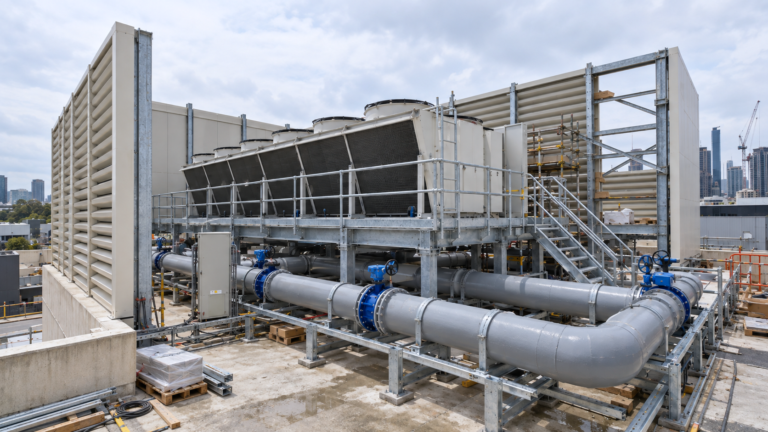
Why rooftop plant changes the noise risk for data centres
Putting heat rejection plant on the roof is usually a sound decision. It frees ground level area for electrical infrastructure and access, it shortens pipe runs, it keeps plant away from vehicle movements, and on… -
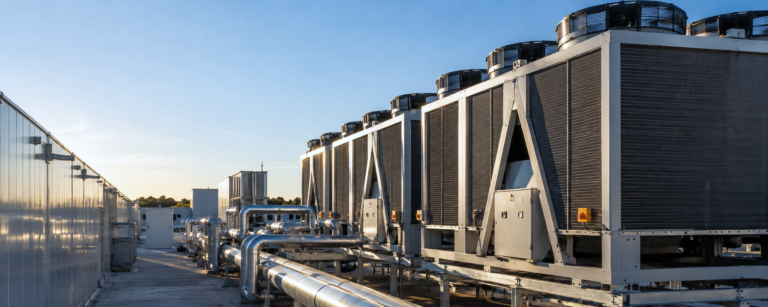
Data centre noise 101 for project teams, where the noise actually comes from
Most data centre noise summaries are written as a list of equipment. Chillers, cooling towers, fans, transformers, generators. The list is accurate and not especially useful, because it does not tell a project team which…