
The acoustic specification brief, what consultants need from suppliers at tender stage
Three suppliers return prices against the same acoustic scope. The spread is forty per cent. Procurement reads that as a commercial finding, asks the lowest bidder to confirm compliance, receives a one line confirmation, and awards. The gap appears eighteen months later during commissioning, when the plant runs and the measured level at the boundary…
Three suppliers return prices against the same acoustic scope. The spread is forty per cent. Procurement reads that as a commercial finding, asks the lowest bidder to confirm compliance, receives a one line confirmation, and awards. The gap appears eighteen months later during commissioning, when the plant runs and the measured level at the boundary sits above the predicted level.
The spread was rarely commercial. In most cases it was a gap in the acoustic specification. The three suppliers were not pricing the same object, because the documentation did not contain enough information for them to design the same object. Each one filled the gaps with its own default assumptions, and each set of defaults produced a different product.
This is the recurring failure in acoustic procurement. It is not caused by suppliers pricing dishonestly. It is caused by a document that states a required outcome without supplying the design inputs needed to reach it.
The difference between an outcome and a design input
A line reading “plant noise shall not exceed 40 dB(A) at the nearest residential receiver” is a performance outcome. It is a legitimate contractual requirement and it belongs in the documentation. On its own it is not a specification, because it transfers the whole design problem to the supplier without transferring the information the supplier needs to solve it.
To turn that outcome into a design, a manufacturer has to know the source sound power spectrum, the propagation path, the receiver distance and height, the assessment period, the meteorological condition assumed in the model, what other plant contributes to the same criterion, and how much of the total budget this item is permitted to occupy. Absent those, the manufacturer either asks, or assumes. Under tender pressure, most assume.
ISO 14163, which sets out guidelines for noise control by silencers, makes the same point in the context of attenuator procurement. It states that acoustical and operational requirements are to be agreed between the manufacturer and the user, and it warns against vague targets such as pressure loss “as small as possible” in place of concrete limit values. The principle generalises across every acoustic component on a project.
Where comparability actually breaks down
Comparability fails in five places, and it usually fails silently.
The first is the acoustic criterion itself. A target expressed only as an overall A-weighted level tells a manufacturer nothing about the shape of the requirement. Two designs can both deliver 40 dB(A) at a receiver while behaving very differently at 63 Hz and 125 Hz, which is where large mechanical plant and reciprocating engines put most of their acoustic energy and where attenuation is hardest and heaviest to buy.
The second is source data. If the specification does not name the sound power spectrum the design is to be based on, and the grade of the data, suppliers will substitute catalogue figures. Sound power determined by an engineering grade method under ISO 3744 and sound power determined by a survey grade method under ISO 3746 are not equivalent inputs, and ISO 3746 is explicitly classed as accuracy grade 3, the lowest of the three grades used in the sound power series.
The third is the metric. Insertion loss, transmission loss and weighted sound reduction index are different quantities produced by different test arrangements, and they answer different engineering questions. A specification that asks for “Rw 35” from an in-duct attenuator has asked for a rating that the relevant test method was not designed to produce for that component. A specification that asks for insertion loss without naming the airflow condition has asked for a number that changes with flow.
The fourth is the mechanical duty. An acoustic component that sits in an airstream is a mechanical component. Its allowable pressure loss, its face velocity, its open area and the fan duty it has to live inside are design constraints, not incidental data.
The fifth is evidence. “Tested” and “modelled” are both legitimate, and they are not the same. A rating produced in a NATA-accredited laboratory carries the traceability of ISO/IEC 17025. A rating produced by calculation aligned to a test standard is a design estimate. Both have a place. A tender that does not distinguish between them cannot compare the submissions it receives.
What a workable specification contains
There is no single format that suits every project, and any attempt to impose one produces documents that are long in the wrong places. What is transferable is the set of questions each input answers.
|
Specification input |
Engineering question it answers |
Common result when it is missing |
|
Design criterion, including assessment period and receiver |
What level, where, and when |
Suppliers design to different targets |
|
Source sound power spectrum and its grade |
What is the component working against |
Catalogue spectra substituted, low frequency underestimated |
|
Required metric and test standard |
Which quantity is being purchased |
Ratings quoted that cannot be compared |
|
Octave band or one third octave requirement |
Where in frequency the attenuation is needed |
Broadband compliance, low frequency shortfall |
|
Airflow rate and allowable pressure loss |
Can the plant still breathe |
Acoustic pass, mechanical failure |
|
Open area and face velocity limits |
Is the airstream condition realistic |
Regenerated noise and rain ingress |
|
Weather and corrosion exposure |
What material and finish is required |
Coastal and process installations under specified |
|
Fire requirements |
What resistance level applies to the assembly |
Non compliant construction late in the programme |
|
Structural interface and wind loading |
How the assembly is supported and fixed |
Support redesign after award |
|
Penetrations, services and access openings |
Where the flanking paths will be |
Predicted performance not achieved on site |
|
Maintenance and personnel access |
Can the plant be operated and serviced |
Doors and panels added without acoustic assessment |
|
Documentation, tolerances and commissioning |
How compliance will be demonstrated |
Disputes at handover |
The table is not a checklist to be issued verbatim. It is the reasoning that sits underneath one.
Different components need different inputs
The specification content changes with what the component is being asked to do, which is why a single generic clause set rarely works across a package.
A Sonic System acoustic modular panel used as an enclosure wall is a building element. The governing acoustic data is airborne sound insulation measured to AS 1191-2002 and rated to AS/NZS ISO 717.1, and the governing non acoustic data is fire resistance level, wind loading to AS/NZS 1170.2, span and support centres. We publish Rw 37dB for the 100mm V100 panel from NATA-accredited laboratory testing, and Rw 45dB for the V100SP from laboratory testing.
A Sonic Series acoustic louvre in the same enclosure wall is a mechanical and acoustic hybrid. Its acoustic rating matters, but so does open area, rain resistance and airflow resistance, because it is the element that lets the plant breathe. We publish this range assessed to AS 1191-2002 and rated to AS/NZS ISO 717.1, with full performance data available on request. A specification should state which class of evidence it requires and accept the consequences for lead time and cost.
A Sonic acoustic attenuator is an airstream component. The relevant acoustic quantity is insertion loss in octave bands at the design flow, together with flow generated noise and total pressure loss, which is the combination the laboratory procedure in ISO 7235 is built to produce. Asking for insertion loss without stating the flow rate is asking for half of a measurement.
A Sonic Access acoustic door is a building element with a service life problem attached. Its laboratory rating, Rw 46dB for the single leaf door and frame system tested to AS 1191-2002 at RMIT University, describes a new door with its seals correctly compressed. The specification also has to address seal type, frame fixing, threshold detail, closing hardware and the operating regime, because those are what determine whether the installed assembly still resembles the tested one in year three.
Tolerances, verification and the closing of the loop
A specification that defines performance but not verification leaves its most contested question to the end of the job.
Three items are worth stating explicitly. The first is what constitutes acceptance, whether that is submission of laboratory data for the supplied configuration, factory measurement, or in situ measurement after installation. The second is the tolerance that applies, because an in situ result and a laboratory result will not agree, and the reasons include flanking transmission, installation workmanship, room and plenum conditions and measurement uncertainty. The third is the condition under which any site test occurs, including plant operating mode, flow rate and background level.
Where in situ verification is intended, the measurement method belongs in the document, and it needs to be a method suited to a field condition rather than a laboratory one.
The commercial argument for a detailed acoustic specification is not that it produces lower prices. Often it does the opposite in the short term, because it removes the room in which optimistic assumptions were previously priced. What it produces is a set of tenders that can be compared on the same basis, and an award decision that survives commissioning.
The practical test of a specification is a simple one. Given only this document, would two competent manufacturers, working independently, arrive at broadly the same product. If the honest answer is no, the document is describing a wish rather than a design, and the difference will be settled on site at a much higher cost than it would have been settled in the tender period.
Related Stories
-
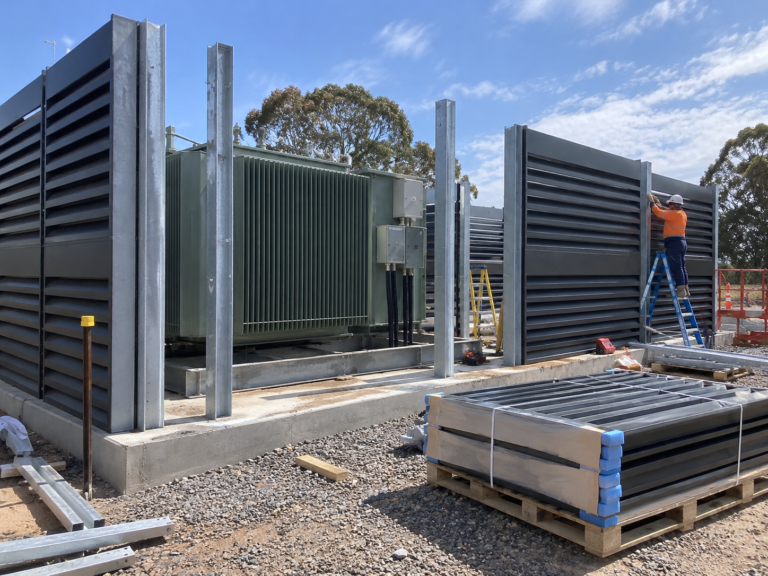
Tonal noise in BESS, why a compliant dB(A) figure may not tell the whole story
An overall A-weighted level answers one question. How much acoustic energy arrives at the receiver, weighted roughly for the sensitivity of human hearing. It does not answer the question residents near battery energy storage sites… -
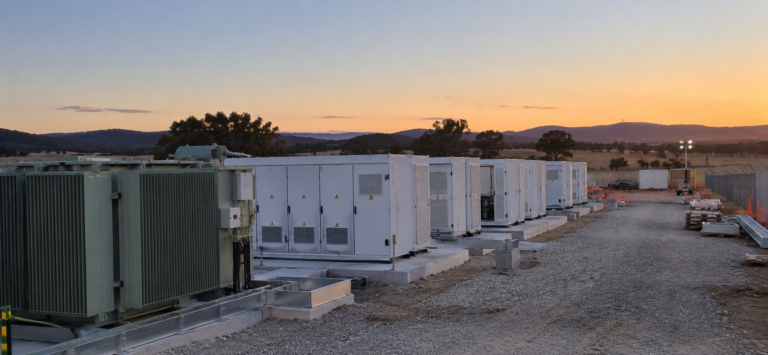
Designing BESS sites for social licence, what noise planning can contribute
In August 2026 the ABC reported on community concern about a proposed 520 megawatt battery energy storage facility at Uriarra Station in the Australian Capital Territory, around two kilometres from Uriarra Village and roughly 30… -

BESS noise 101, fans, chillers, inverters and transformers explained
Battery energy storage is often described as quiet technology, and at the cell level that is true. There is no combustion, no reciprocating machinery and no prime mover. Everything around the cells is a different…