
Acoustic walls and enclosures, how to decide which approach fits the plant
Whether a noisy piece of plant gets an acoustic wall or a full acoustic enclosure is often settled on budget, with the enclosure cast as the better option and the wall as the cheaper fallback. The two treatments interrupt the path between source and receiver in different ways. The right choice comes from how the…
Whether a noisy piece of plant gets an acoustic wall or a full acoustic enclosure is often settled on budget, with the enclosure cast as the better option and the wall as the cheaper fallback. The two treatments interrupt the path between source and receiver in different ways. The right choice comes from how the source radiates, the geometry of the site and the constraints around the plant, as much as from the size of the reduction needed.
A wall works by forcing sound to diffract
An acoustic wall built from Sonic System acoustic modular panels works as a barrier. It breaks the line of sight between source and receiver, so sound reaching the receiver has to diffract over or around the top edge. That diffraction loss produces the attenuation.
ISO 9613-2 sets out the barrier calculation, deriving attenuation from the path-length difference between the direct path and the diffracted path around the edge. So a wall’s performance isn’t a fixed number. It depends on the height and position of the barrier relative to the source and receiver, the distance between them, and the frequency content of the noise, because longer wavelengths diffract around an edge more readily than shorter ones. A wall that comfortably controls a high-frequency compressor may do far less for a low-frequency blower at the same boundary.
A wall also treats only the paths it interrupts. If the receiver can see the source from another angle, around the end of the wall or over a lower section, that path is untreated. Wall length, height and end conditions need to be set from the real source and receiver geometry, not a generic standoff distance.
Our Sonic acoustic walls are built from the V50 or V100 panel. Both have been through NATA-accredited laboratory testing to AS 1191-2002, with Rw determined to AS/NZS ISO 717.1. The V50 achieves Rw 31dB and the V100 Rw 37dB, with sound absorption tested to AS ISO 354 giving an NRC of 1.00 and 1.10 respectively. Those figures describe the panel’s own transmission loss and absorption. The attenuation at a given receiver still depends on the diffraction geometry, not on the panel rating alone.
An enclosure works by transmission loss through its surfaces
A full or partial enclosure surrounds the source, so it controls transmission through its surfaces instead of relying on diffraction around an edge. With the source contained on some or all sides, the enclosure doesn’t depend on breaking a single line of sight.
That’s why enclosures get specified when noise has to come down in every direction, when the receiver is close enough that diffraction losses would be small whatever the wall height, or when the source carries strong low-frequency content that a barrier of practical height can’t diffract around efficiently.
The trade-off is that an enclosure has to manage everything a wall doesn’t. Equipment inside usually needs ventilation and heat rejection, so the enclosure has to incorporate acoustic louvres or attenuated openings rather than relying on sealed panel alone. It has to give access for operation and maintenance, which brings in doors. Every door, louvre and penetration is a potential weak point if it isn’t treated to a standard comparable with the surrounding panel.
Our Sonic acoustic enclosures combine Sonic System acoustic modular panels (up to Rw 45dB in the V100SP), Sonic Series acoustic louvres (up to Rw 33dB) and Sonic Access acoustic doors (up to Rw 52dB in the high-performance range). An enclosure’s reduction varies with frequency too, typically lowest at 125Hz and highest in the upper octaves, though for a different physical reason than barrier diffraction. An enclosure is only as good as its weakest component, so louvre and door selection has to be matched to the panel rating, not treated as a secondary decision.
Match the treatment to the source and the site
Source directivity matters. A source that radiates strongly in one direction, such as a fan discharge or an open compressor bay, may be adequately treated with a wall or partial screen on the dominant radiation path. A source that radiates broadly, such as a generator set with several noisy surfaces, is harder to treat with one wall without leaving other paths open.
Site geometry matters as much. Available space, plant footprint and the standoff to the nearest receiver all set how much diffraction loss a wall of practical height can deliver. On a tight site with the receiver close to the source, a wall may need to be impractically tall, and an enclosure becomes the more practical option even when the target dB(A) reduction is moderate.
Ventilation and heat load are decision points in their own right. Plant that generates a lot of heat needs a ventilation strategy before an enclosure is finalised; retrofitting louvres into an enclosure designed without them compromises both acoustic performance and airflow. A wall doesn’t carry this constraint in the same way, since the source stays in open air.
Assess access and maintenance requirements before selecting the treatment. An enclosure with poorly placed doors, no allowance for equipment removal, or no provision for future plant modification risks panels or doors being left open, removed or bypassed during routine work, and that undermines the acoustic performance however well the assembly was specified.
Consider future modification and expansion at the same stage. A modular wall or panel enclosure can generally be extended or reconfigured more easily than a purpose-built fixed structure, but that flexibility has to be planned into the layout. It can’t be assumed.
Mixed treatments are common on industrial sites
In manufacturing environments, mixed treatments are common. A production line with several noise sources at different distances from the site boundary might use a perimeter wall to manage cumulative boundary noise, combined with a targeted enclosure around one loud machine closer to a sensitive receiver.
Water treatment and pump station sites often favour partial enclosures around pumps and blowers, where ventilation and access to seals and bearings are ongoing operational needs. Infrastructure projects with staged construction, such as BESS and data centre sites, often use relocatable Sonic acoustic walls during construction and move to fixed enclosures once equipment layouts are finalised.
Choose from the source, the geometry and the access needs together
Neither treatment is inherently better. A wall suits breaking a specific line of sight where the source and receiver geometry support it, and it leaves access to the plant untouched. An enclosure suits broadband, all-direction containment where diffraction alone won’t reach the target, and it brings ventilation, access and maintenance obligations that have to be designed in from the start. The right specification comes from source directivity, receiver geometry, standoff distance, frequency content, ventilation and access considered together.
Talk to the AcousTech team about your project.
Related Stories
-
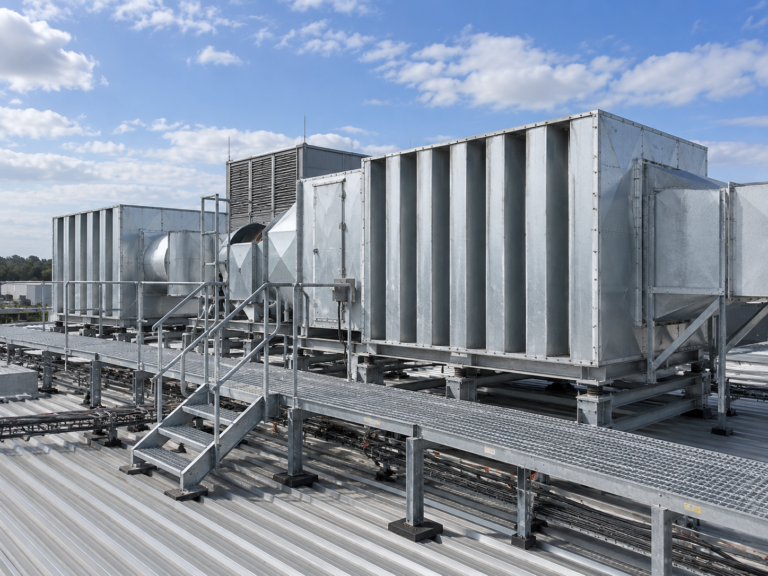
Attenuator sizing, balancing insertion loss, airflow and pressure drop
An attenuator selection sheet usually contains two numbers that people look at and one that decides whether the selection works. The two are insertion loss and pressure loss. The one is airway velocity, and it… -
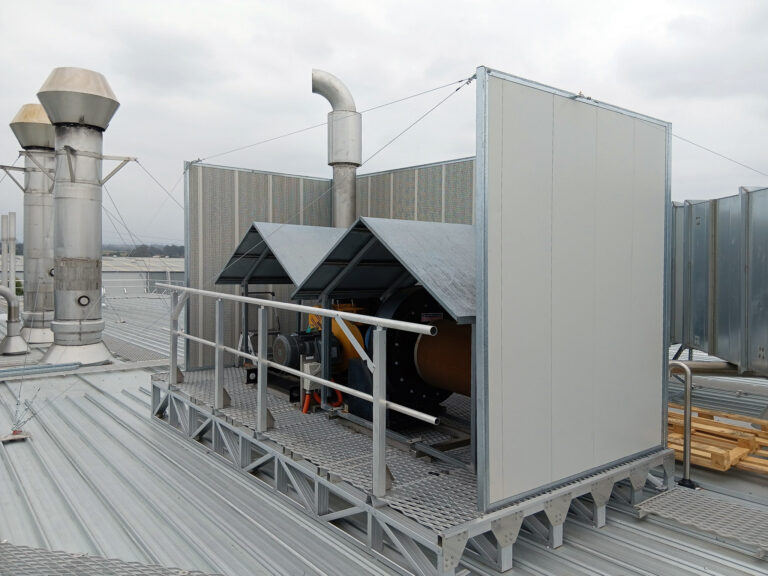
When an acoustic louvre is the right choice and when it is not
An acoustic louvre is asked to do three incompatible things through the same aperture. It has to let air through, keep water out, and attenuate sound. Each of those improves at the expense of the… -
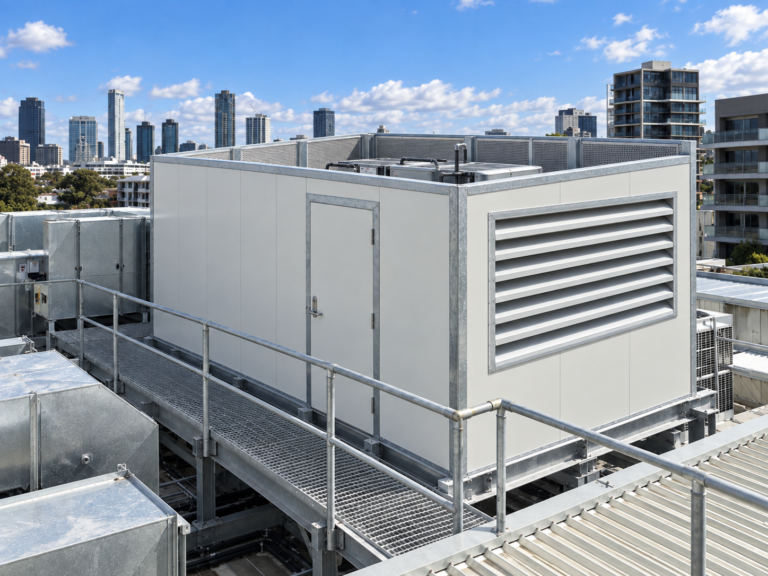
Insertion loss, transmission loss and Rw, choosing the right metric for the job
A mechanical engineer sizing a duct attenuator, an architect specifying a plantroom wall and a project manager reviewing a supplier submission can all be looking at a number followed by the letters dB and be…