
Designing acoustic infrastructure that can scale with future capacity
Most large data centre, industrial, and energy infrastructure projects are designed with staged expansion in mind. Site masterplans show future building footprints, additional mechanical plant bays, expanded cooling infrastructure, and increased electrical capacity. The capital planning process allocates investment to stage one and defers the rest. What the masterplan rarely shows with equivalent clarity is…
Most large data centre, industrial, and energy infrastructure projects are designed with staged expansion in mind. Site masterplans show future building footprints, additional mechanical plant bays, expanded cooling infrastructure, and increased electrical capacity. The capital planning process allocates investment to stage one and defers the rest. What the masterplan rarely shows with equivalent clarity is the acoustic infrastructure needed to support that expansion without compromising compliance or creating costly retrofit obligations.
The acoustic implications of staged expansion are routinely underestimated in initial project planning. Stage one acoustic modelling is undertaken on the basis of stage one equipment and stage one site configuration. It demonstrates compliance for the approved scope. When stage two commences, the noise environment established by stage one becomes the baseline against which stage two sources must be assessed. If stage one has consumed most of the available acoustic budget at surrounding receivers, stage two faces constraints that can only be addressed through acoustic treatment more intensive than the stage one design required.
The acoustic planning problem on staged infrastructure is not difficult to resolve, but it requires engagement earlier in the design process than most project teams currently allow for.
Acoustic headroom and the staged expansion problem
The noise level at any given receiver is determined by the combined contribution of all sources on the site, attenuated by distance, ground cover, and any barriers or screening. When a site is fully developed, the total source contribution to any receiver will reflect the cumulative effect of all plant operating simultaneously. If the applicable criterion at that receiver is 40dB(A), the fully built-out site must achieve that criterion across all operating scenarios.
If stage one is designed to achieve exactly 40dB(A) at the receiver, the fully developed site has no acoustic headroom for the additional sources that stage two will introduce. Depending on the number and sound power levels of those sources, stage two could add several decibels to the receiver level that stage one was already occupying. Even relatively small additional source contributions increase the overall receiver level, because environmental noise combines logarithmically rather than arithmetically. A source at a comparable level to the dominant adds approximately 3dB to the combined result. An already compliant level has very little tolerance for that.
Future-proofing an acoustic design requires stage one to achieve a receiver level appreciably below the applicable criterion, preserving headroom for future development. The precise amount of headroom required depends on the expected source contribution of future stages, which should be estimated from the masterplan equipment assumptions even where those assumptions are preliminary. A stage one design that consumes a large proportion of the available acoustic headroom at key receivers is unlikely to support efficient future expansion, even if stage one itself is technically compliant.
Sizing acoustic products for future plant
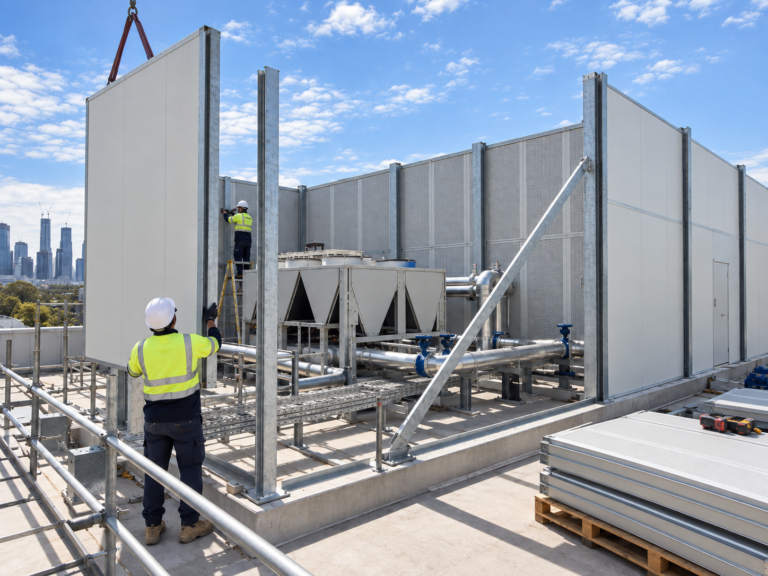
Beyond the headroom question, the physical acoustic infrastructure installed as part of stage one must be capable of accommodating the loads that future expansion will place on it. Acoustic louvres sized for stage one airflow may be inadequate for the combined airflow required when additional cooling plant is added. Attenuators specified for stage one duct sizes may need replacement or supplementation when ductwork is extended to serve additional equipment. Acoustic barriers positioned to screen stage one plant may become ineffective when stage two plant is positioned behind them.
This is not a hypothetical problem. Project teams frequently discover that acoustic barriers installed as part of stage one approvals need modification or extension when stage two development is submitted for planning consent, because the barrier was sized for stage one source levels and cannot provide adequate attenuation for the increased source contribution of the expanded site.
Designing acoustic infrastructure to accommodate future loads requires the masterplan acoustic analysis to inform the specification of stage one products. A Sonic Series acoustic louvre with a larger free area than stage one strictly requires may accommodate future plant additions without replacement. A barrier designed to a height that accounts for future plant on the other side costs only marginally more to build at stage one than a barrier sized purely for current sources.
How site layout determines future acoustic options
The spatial layout of a staged facility has lasting consequences for acoustic management. Mechanical plant positioned close to site boundaries in stage one limits the setback available for future plant additions. Acoustic barriers installed close to existing plant to address stage one compliance may conflict with the access, maintenance, and ventilation requirements of future plant in the same location.
Acoustic modelling of the fully built-out masterplan, undertaken during stage one design, identifies where spatial conflicts between future plant and acoustic requirements are likely to arise. It allows the stage one site layout to be configured in a way that preserves viable acoustic treatment options for future stages, rather than foreclosing those options by default.
For data centre campuses where hyperscale growth is anticipated, this spatial planning consideration has particular significance. The cooling plant serving a future high-density compute hall may produce sound power levels considerably higher than stage one cooling plant, and its position relative to sensitive receivers will determine whether compliant outcomes are achievable. Positioning that plant at design stage, even where it will not be installed for several years, allows the acoustic infrastructure to be planned around it from the outset.
Commissioning stage one in a multi-stage context
Post-commissioning verification testing on staged projects is typically undertaken to confirm that stage one meets its consent conditions. The results of that testing are important not only as evidence of stage one compliance but as calibration data for the acoustic model that will be used to assess future stages. Where measured levels differ from predicted levels, understanding the reasons for that difference is essential to maintaining predictive accuracy as the site develops.
A measured receiver level that is higher than predicted by the stage one model, even if it remains within the consent criterion, suggests that the model is underestimating source contributions. If that underestimation is carried forward into the stage two assessment, the predicted outcomes for the expanded facility will also be optimistic. The model calibration work that identifies and corrects systematic prediction errors is a valuable investment in the reliability of future assessments.
AcousTech’s range of Sonic Series acoustic louvres and Sonic acoustic attenuators is regularly specified on staged data centre and industrial projects where the brief includes accommodating future plant additions. Product selection in these contexts should consider the free area, acoustic performance, and physical configuration of the specified product, and whether it can be adapted or supplemented as loads increase. AcousTech’s data centre acoustics expertise supports this planning approach across the project lifecycle.
Acoustic masterplanning across the project lifecycle
The acoustic design of a staged facility is most productively approached as a long-term infrastructure planning exercise rather than a series of independent consent applications. Each stage of development occurs within the acoustic context established by previous stages, and the cumulative impact of those decisions determines the acoustic performance of the fully developed site.
Project teams that invest in a full acoustic masterplan at the outset of development are better placed to manage compliance across stages, identify and resolve conflicts early, and present credible evidence to planning authorities that future development is acoustically manageable. That investment pays dividends at each subsequent consent application, where the acoustic assessment can demonstrate a consistent and foreseeable design trajectory rather than responding reactively to the consequences of earlier decisions.
The acoustic decisions made in stage one are not reversible once construction is complete. Treating acoustic masterplanning as an integral part of infrastructure planning from the outset is considerably cheaper than correcting those decisions later.
Talk to the AcousTech team about your project.
Related Stories
-
The acoustic specification brief, what consultants need from suppliers at tender stage
Three suppliers return prices against the same acoustic scope. The spread is forty per cent. Procurement reads that as a commercial finding, asks the lowest bidder to confirm compliance, receives a one line confirmation, and… -

What Australia’s data centre boom means for acoustic design before DA submission
In August 2026 the NSW Government published the NSW Data Centre Guidelines, which record around 60 data centres already operating in the state and 19 projects in the State Significant Development pipeline valued at $50.3… -
Australia’s renewable energy buildout is creating an infrastructure coordination challenge
The renewable energy construction programme running across Australia is unlike anything the sector has delivered before. Wind, solar, battery storage, and the transmission infrastructure connecting them are all being built simultaneously, in locations that are…