
Duct-borne noise transmission in complex networks
In a simple duct system, noise propagation follows a clear path: a fan generates acoustic energy, which propagates through the duct toward the terminal or discharge point, attenuated by lining, bends, and any deliberately installed attenuation elements. This model, which forms the basis of most standard duct system acoustic calculations, is a reasonable approximation for…
In a simple duct system, noise propagation follows a clear path: a fan generates acoustic energy, which propagates through the duct toward the terminal or discharge point, attenuated by lining, bends, and any deliberately installed attenuation elements. This model, which forms the basis of most standard duct system acoustic calculations, is a reasonable approximation for short, simple ducts serving a single zone. In large, branched networks serving multiple zones across multiple floors, it fails in ways that require a different approach.
Complex duct networks create multiple parallel propagation paths. Noise from a central plant item does not simply travel from source to discharge; it propagates simultaneously through every connected branch, at levels that depend on the geometry and acoustic impedance of each path. Noise also exits the ductwork laterally, radiating through duct walls into the spaces through which the duct passes. And in systems where ductwork connects adjacent spaces, acoustic energy can travel from one occupied zone to another through the duct itself, creating cross-talk problems that have nothing to do with the original noise source.
These problems are familiar to acoustic engineers working on large commercial, education, or healthcare projects. They are less visible to project teams that treat duct acoustic design as a straightforward attenuation calculation, and the consequences surface at commissioning and post-occupancy review when correction options are limited.
Duct breakout and wall transmission
Sound waves propagating through a duct interact with the duct wall, which has a finite mass and stiffness. Where the acoustic pressure within the duct is sufficient to excite the wall, some energy is radiated through the wall into the surrounding space. This is duct breakout, and it is distinct from the noise that exits at the duct opening. Breakout bypasses any attenuation installed downstream of the breakout point and arrives at the receiver through a path that standard duct acoustic calculations do not account for unless it is specifically assessed.
The magnitude of duct breakout depends on the sound transmission loss of the duct wall, which is primarily governed by wall mass. Thin-walled circular or rectangular ducts provide modest transmission loss, typically 10 to 20dB in the mid-frequency range, and substantially less at low frequencies. For systems with high sound power levels in the duct, particularly in the main trunk immediately downstream of the fan, breakout from unlined ductwork passing through or adjacent to occupied spaces can dominate the noise environment in those spaces.
Increasing duct wall mass through heavier gauge material, lagging, or composite wall construction reduces breakout. For rectangular ducts, duct wall panel resonances can produce local transmission loss minima at specific frequencies; these should be identified and addressed in the duct specification. In situations where a duct passes through an acoustically sensitive space, such as a bedroom in a hotel or a consultation room in a healthcare facility, breakout should be assessed explicitly rather than assumed to be negligible.
Cross-talk between zones
Duct cross-talk occurs when airborne sound from one room or zone travels back through the duct system and is transmitted into an adjacent zone via a shared duct connection. It is most acute in systems where supply or return ducts serving adjacent spaces are connected to a common plenum or trunk without adequate acoustic separation between branch connections.
The acoustic path in a cross-talk scenario runs from the source room, through the terminal into the duct, along the duct network to the adjacent branch connection, and out through the terminal into the receiving room. The attenuation along this path depends on the transmission loss of the terminals, the duct lining performance, and the path length between the two connections. In compact ceiling plenum arrangements, path lengths can be very short and cross-talk attenuation correspondingly low.
The environments where cross-talk is a genuine design concern extend well beyond the commercial office. In healthcare facilities, ductwork serving plant rooms and adjacent ward or consultation areas can carry noise from mechanical equipment into spaces where speech privacy and low background levels are both required. In education buildings, a single air handling unit serving multiple teaching spaces via a shared trunk creates a cross-talk path between classrooms that can compromise acoustic separation achieved through the building structure.
Data centres with co-located operations offices face cross-talk risks where ductwork serving high-density IT cooling zones connects to systems serving occupied spaces. Government and defence facilities with sensitive briefing or operations rooms adjacent to mechanical services require cross-talk analysis as part of the security acoustic assessment. In each of these contexts, addressing cross-talk after fitout is more disruptive and expensive than designing for it at the outset.
Propagation at junctions and terminations
The standard duct network calculation model treats junctions as simple power-splitting elements, where sound power is distributed among branches in proportion to their areas. This is an approximation that ignores frequency-dependent junction losses and reflection effects. At low frequencies and at junctions with significant area contrasts, these effects can be material.
Area contrasts at junctions, such as a large trunk connecting to a small branch, create acoustic impedance mismatches that cause partial reflection of incident energy back toward the source. In some configurations, this reflected energy can superimpose constructively with the incident field and create standing wave patterns in the upstream duct. These standing waves do not affect the steady-state propagation analysis significantly, but they can produce frequency-specific level variations that are difficult to explain from a simple one-dimensional model.
At duct terminations, particularly at grilles and diffusers opening into rooms, the transmission from the duct to the room involves a further impedance change. The end correction for a duct opening is frequency-dependent, and at low frequencies the radiation efficiency of a small opening is reduced. Standard models that treat the terminal as a simple sound source without accounting for this radiation characteristic may overestimate low-frequency sound levels in the room.
Design strategies for complex networks
Addressing noise propagation in complex networks requires a model that represents the network topology, the acoustic properties of each element, and the relevant propagation paths, including breakout and cross-talk, rather than a single-path calculation. Several commercial acoustic software platforms support network-based duct system analysis at this level of detail.
At the design level, the most productive strategies involve managing noise at the dominant sources within the network rather than attempting to treat every branch individually. Placing attenuators at key junctions where several branches are served from a common trunk concentrates treatment at the points of highest energy, reducing the attenuation burden on downstream elements. Acoustic lining of the main trunk immediately downstream of the fan addresses the segment of highest sound power before energy distributes into branches.
For cross-talk control, increasing the angular separation between adjacent branch takeoffs on a common trunk, and ensuring that each sensitive zone has an independent branch connection rather than sharing a plenum with adjacent spaces, are the most direct architectural measures. Where this is not feasible, attenuators on individual branch circuits or acoustic terminals with higher back-attenuation provide an alternative.
Sonic acoustic attenuators and duct-mounted acoustic treatment elements can be configured and positioned within network layouts to address the specific propagation paths identified by network analysis, rather than applied generically based on source level alone.
Duct network acoustics in complex building services systems is not well served by single-path calculation methods that assume linear propagation from source to room. Breakout, cross-talk, junction reflection, and multi-path propagation all influence the acoustic environment in ways that these methods cannot capture. Managing noise in complex networks requires a full assessment of the network topology, identification of the dominant propagation paths, and treatment applied at the points where it will be most effective. The investment in network-level analysis during design is typically smaller than the cost of identifying and correcting network-related noise issues after the building is occupied.
Talk to the AcousTech team about your project
Related Stories
-
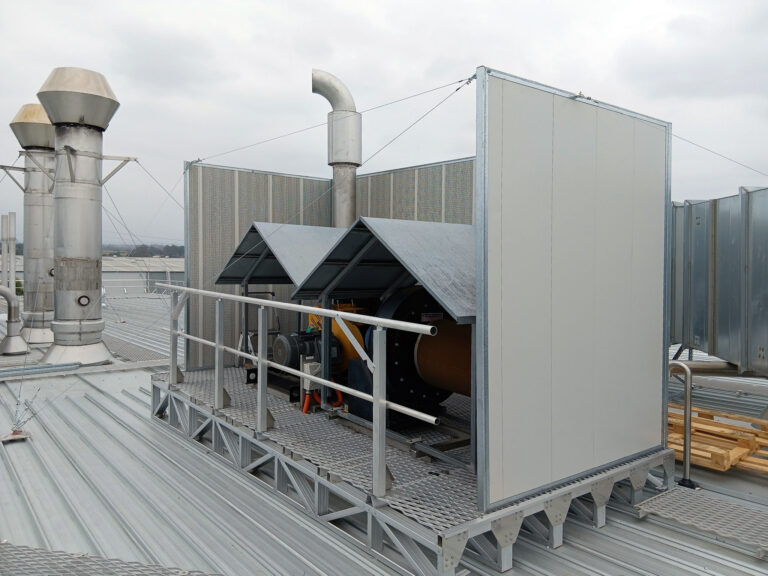
When an acoustic louvre is the right choice and when it is not
An acoustic louvre is asked to do three incompatible things through the same aperture. It has to let air through, keep water out, and attenuate sound. Each of those improves at the expense of the… -
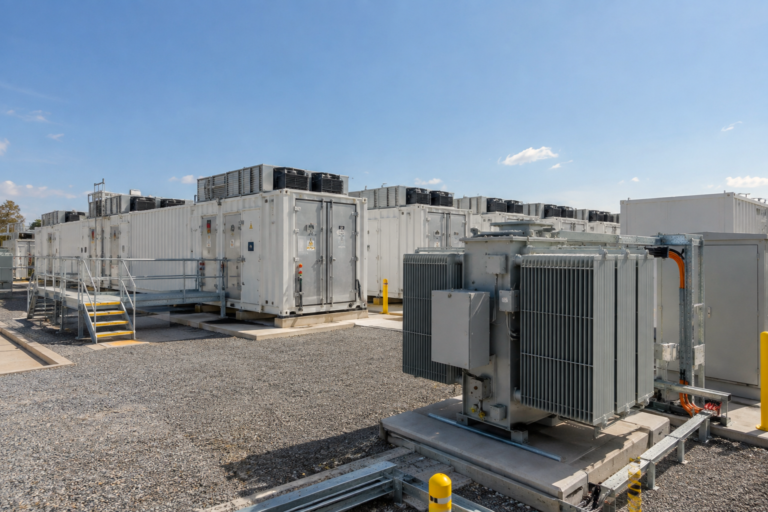
BESS noise 101, fans, chillers, inverters and transformers explained
Battery energy storage is often described as quiet technology, and at the cell level that is true. There is no combustion, no reciprocating machinery and no prime mover. Everything around the cells is a different… -
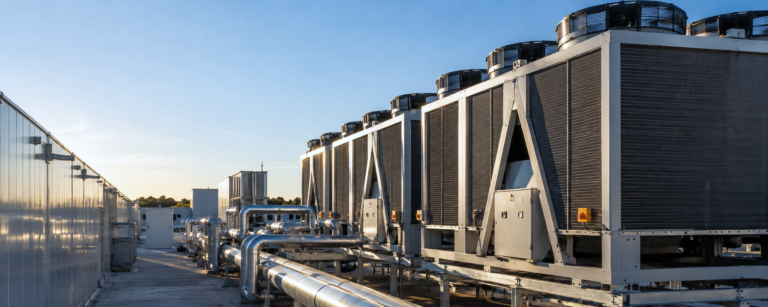
Data centre noise 101 for project teams, where the noise actually comes from
Most data centre noise summaries are written as a list of equipment. Chillers, cooling towers, fans, transformers, generators. The list is accurate and not especially useful, because it does not tell a project team which…