
Balancing pressure drop and acoustic performance
The relationship between acoustic performance and pressure drop in ducted attenuation systems is one of the more consequential trade-offs in mechanical services engineering. More acoustic media means more insertion loss, but it also means more resistance to airflow, higher fan energy consumption, and in many cases, a larger fan to maintain the required duty. This…
The relationship between acoustic performance and pressure drop in ducted attenuation systems is one of the more consequential trade-offs in mechanical services engineering. More acoustic media means more insertion loss, but it also means more resistance to airflow, higher fan energy consumption, and in many cases, a larger fan to maintain the required duty. This trade-off is unavoidable, but it is not unmanageable, and the outcomes of poor management show up in two ways: systems that fail to meet noise criteria because attenuation has been under-specified, and systems that meet noise criteria but consume more energy than was anticipated because attenuation was over-specified without regard for the aerodynamic consequences.
The core problem is that pressure drop and insertion loss are governed by the same geometric variables. Splitter length, thickness, and spacing all influence both parameters simultaneously, and optimising for one without accounting for the other produces suboptimal results. A design that treats the attenuator in isolation from the fan system it serves is incomplete, regardless of how well the attenuation performance has been characterised.
Attenuator geometry and the governing trade-off
Splitter attenuators are characterised by the width and spacing of their acoustic elements, the depth of the absorptive fill, and the overall length of the attenuating section. Each of these variables affects both insertion loss and pressure drop, but not in equal measure at all frequencies.
Increasing splitter length improves insertion loss across the frequency range, with the greatest proportional gain at lower frequencies where shorter sections underperform. Pressure drop increases approximately in proportion to length. Increasing the depth of absorptive fill improves mid-to-high-frequency performance but yields diminishing returns at low frequencies and increases resistance by reducing the free airway area. Reducing splitter spacing, which increases the number of splitters per unit width, delivers higher attenuation per metre of length but concentrates the resistance over a shorter path, increasing pressure drop at equivalent face velocities.
The net result is that high-insertion-loss designs are invariably high-pressure-drop designs. A 30dB(A) insertion-loss silencer will almost certainly impose a higher pressure drop than a 15dB(A) unit with similar face dimensions. The question for the designer is not whether to accept this, but how to manage it within the system’s constraints.
Fan curve interaction
No attenuator can be assessed in isolation from the fan system it is connected to. The operating point of any fan is determined by the intersection of its pressure-volume characteristic with the resistance curve of the system it serves. Introducing an attenuator into a duct system raises the total system resistance, shifting the fan operating point along its characteristic curve.
Depending on the shape of the fan curve and where the original design point sits, the effect of added resistance can range from a modest reduction in airflow to a displacement toward an unstable operating region. Centrifugal fans with backward-curved impellers are generally tolerant of increased system resistance, while forward-curved designs are more sensitive and can be pushed into stall conditions if resistance increases substantially.
The implication is that attenuator pressure drop must be accounted for in the system resistance calculation from the outset, not retrospectively. Discovering at commissioning that a specified attenuator imposes a pressure drop that the system cannot accommodate without a fan upgrade is a foreseeable outcome of poor coordination between acoustic and mechanical design.
Regenerated noise at high face velocities
A further complication arises when attenuators are sized to fit available space rather than to deliver acceptable aerodynamic performance. When face velocity through the attenuator exceeds recommended limits, typically around 6 to 8 m/s for standard designs, the turbulent boundary layer interaction with the splitter surfaces generates flow-induced noise within the attenuator itself.
This regenerated noise is produced downstream of the attenuating section and therefore receives no benefit from the insertion loss of the attenuator. At high velocities, regenerated noise can partially or entirely negate the attenuation of the source noise, and the net acoustic performance of the attenuator falls well below its rated insertion loss. The relationship between velocity and regenerated noise level is steep, typically rising at 50 to 60dB per decade of velocity increase, so the problem becomes severe rapidly once velocity thresholds are exceeded.
Regenerated noise is a particular risk in constrained plant rooms where attenuator face areas are compressed to fit within spatial allowances. Confirmation that face velocities are within acceptable limits should be a routine part of attenuator specification, not an afterthought.
System-level optimisation
The most direct approach to balancing acoustic and aerodynamic performance is to treat the attenuator, fan, and duct system as a single design problem from the early stages. This requires close coordination between the acoustic consultant or engineer and the mechanical services team.
Fan selection should precede or coincide with attenuator specification where possible. Knowing the fan type, duty point, and curve characteristics allows the acoustic designer to understand how much additional system resistance can be tolerated before operational performance is compromised. This, in turn, allows attenuation performance targets to be allocated between the attenuator and other noise control measures, such as acoustic lining or duct routing, rather than concentrating all requirements in a single high-resistance element.
Where insertion loss requirements are high and pressure drop is constrained, attenuator length is usually the preferred variable to optimise. Longer, less-resistive attenuators can match the insertion loss of shorter, more-resistive units across many frequency ranges, with much less impact on system resistance. This requires space, which again argues for early acoustic input into plant room layout planning.
AcousTech’s Sonic acoustic attenuators are configured to project-specific performance requirements, allowing splitter geometry to be optimised against both insertion loss targets and pressure drop constraints. Selecting a standard catalogue product without that optimisation risks over-specifying resistance at the expense of fan performance.
Pressure drop and acoustic performance are inseparable in ducted attenuation design. Managing the trade-off between them requires a system-level perspective that begins at the earliest stages of design and involves close coordination between acoustic and mechanical disciplines. Treating the attenuator as a standalone product selected to meet a noise criterion without regard for its aerodynamic consequences is a reliable path to either non-compliance or unnecessary energy consumption. The more productive approach is to design for both acoustic and aerodynamic performance together, using the full range of geometric variables available and grounding the specification in a realistic model of fan-system interaction.
Talk to the AcousTech team about your project.
Related Stories
-
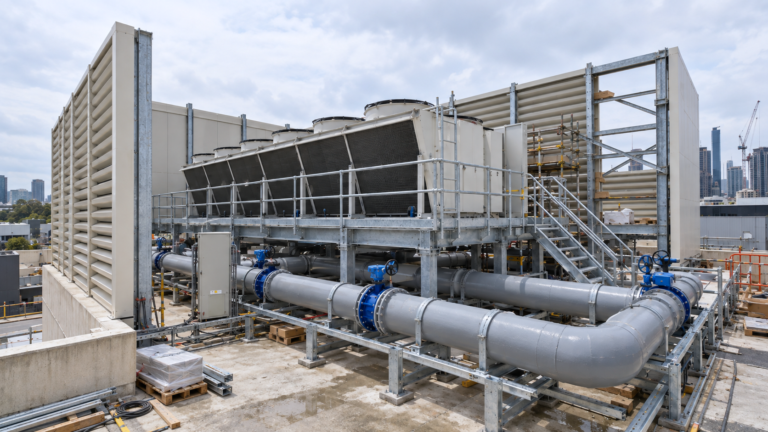
Why rooftop plant changes the noise risk for data centres
Putting heat rejection plant on the roof is usually a sound decision. It frees ground level area for electrical infrastructure and access, it shortens pipe runs, it keeps plant away from vehicle movements, and on… -
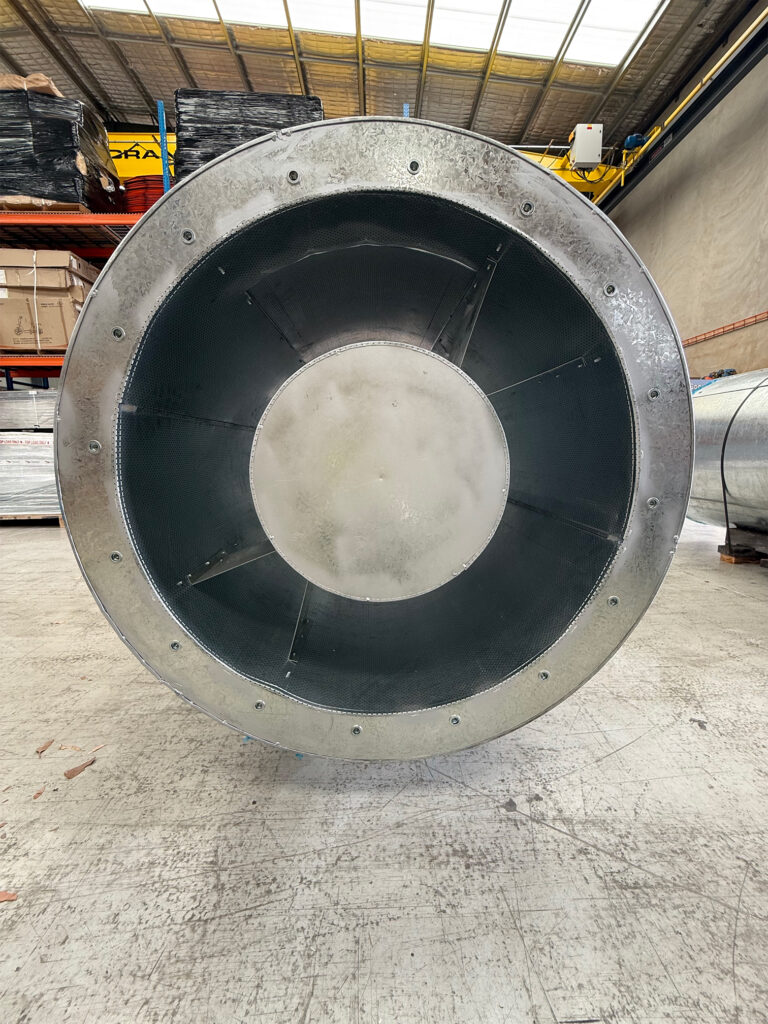
Why tonality in modern mechanical plant is becoming a project risk
Tonal noise from mechanical plant is not a new engineering problem. It has been present in HVAC and industrial equipment for as long as rotating machinery has been used to move air and fluid. What… -
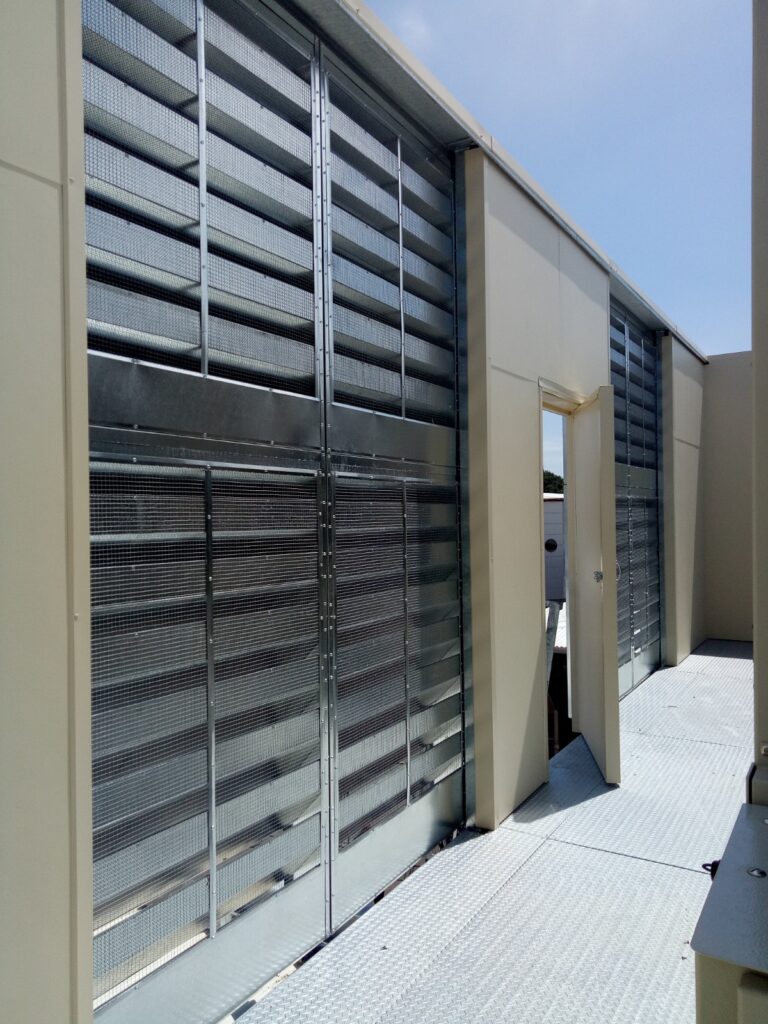
Cumulative noise impacts in clustered installations
Infrastructure and industrial development patterns have changed considerably in recent decades. Data centres that once occupied isolated suburban sites are now located in urban industrial precincts, often clustered with other continuous-operation facilities. Battery energy storage…