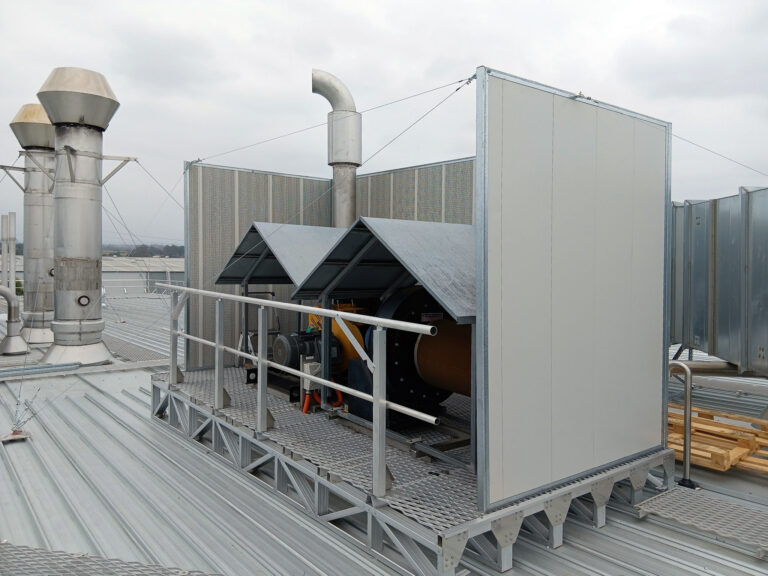
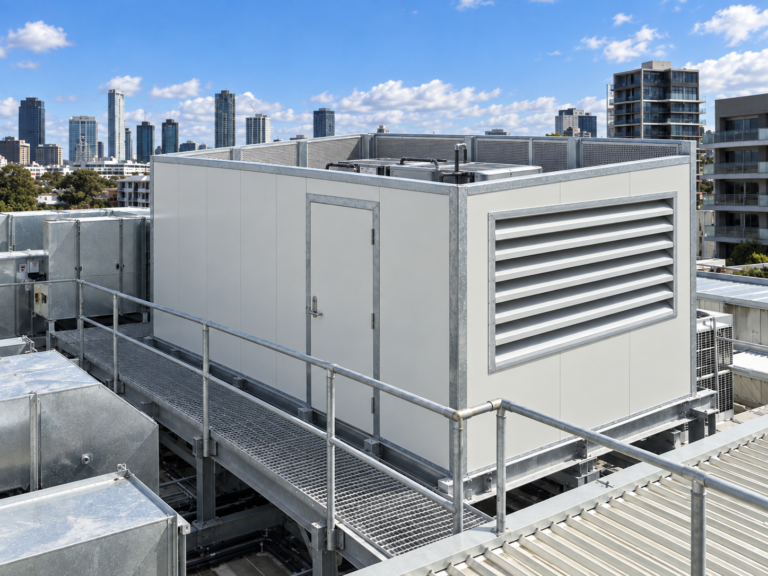
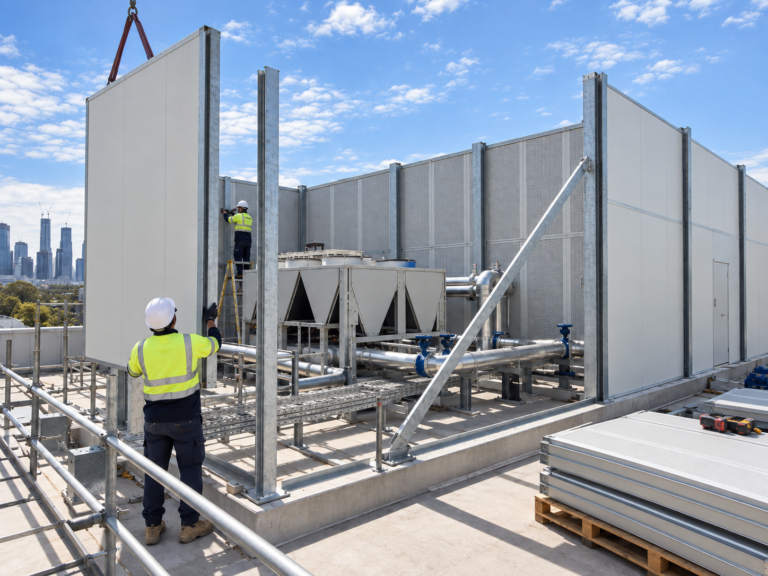
Taking the Science of Silence from lab to reality
Acoustic predictions give designers a sense of confidence. A neat TL curve, a clear datasheet, and a model that appears to track with the familiar 6 dB relationship all help them sleep better at night.
Yet once installation begins, the real world often reveals behaviour that the laboratory never hinted at. This gap between prediction and site performance is where the AcousTech team spends much of its time, applying the Science of Silence to understand what is really happening.
This article follows on from our earlier look at IL, TL, and NR, and examines why field outcomes sometimes stray from expectations. Acoustic predictions are central to this discussion.
Why TL cannot guarantee NR
A TL rating reflects how an acoustic material behaves in a controlled test suite. Boundaries are fixed, absorption is consistent, and the mounting method is prescribed. None of these conditions apply once the panel is placed inside an industrial environment.
On-site, the same panel interacts with framing, fixings, geometry, and the absorption of the receiving space. NR becomes the true measure, shaped by the entire installation rather than the material alone.
Even Flexshield Group panels – engineered for consistency across projects – rely on the surrounding structure to reach their full capability. TL provides intent; NR reveals reality.
Flanking paths: the most common source of error
Flanking is one of the most frequent reasons that acoustic predictions fall short. Energy seeks alternate pathways that bypass the acoustic barrier entirely. These pathways can be small yet powerful. Perimeter gaps. Continuous steel. Slab edges. Cable penetrations. Mounts that couple two structures.
A panel may deliver excellent TL in the lab yet show lower NR on-site, purely because the sound found a different route. This is why AcousTech field investigations spend as much time studying construction details as the panel itself.
Why room absorption is often overlooked during design
Many prediction models assume the receiving room behaves similarly to the test environment, yet this is rarely the case. A hard, reflective room can reinforce sound, while a room with absorptive finishes can diminish it.
The familiar 6 dB relationship between TL and NR applies only when reverberance is similar on both sides of the barrier. Once surfaces, volumes, or absorption change, the relationship breaks down.
Installation quality – where theory meets practice
Installation choices have a profound impact on NR. A flexible panel that’s fixed too rigidly may shift into resonance. A heavy barrier supported by a lightweight frame may vibrate as one assembly, rather than working as designed.
AcousTech composite partitions, liners, and infill panels are built to balance mass and stiffness. Their performance depends on the detailing that surrounds them. When mountings, seals, and perimeter treatments follow best practice, NR moves closer to the designer’s intent.
Restoring accuracy to acoustic predictions
Accurate field performance requires more than simply reading a datasheet. It calls for an understanding of how materials behave once paired with structures, joints, and real rooms. When mass, stiffness, framing paths, sealing, and absorption are considered together, NR becomes far more predictable.
This is the point where the AcousTech team thrive. We treat each installation like a scientific investigation, drawing on our decades of curiosity and hands-on experience. Our aim is simple: to deliver workplaces shaped by clarity and calm, backed by thoughtful engineering and the Science of Silence.
To talk to the specialists at AcousTech, call 1300 508 232.
Trusted by engineers, built for performance.
That’s the Science of Silence.