Tips when engineering quiet spaces
Creating a quiet workspace demands more than just reading IL, TL, and NR values. The acoustic material choices made for each project will shape how energy behaves, how structures respond, and whether a design performs as predicted once it’s installed. This article builds on our earlier discussion of acoustic metrics by exploring how material choices influence outcomes across real projects.
Mass and low-frequency control
Mass is one of the few reliable tools for improving TL at lower frequencies. And while heavy constructions resist airborne energy, performance is shaped just as much by framing and mounting. Two panels with identical weight can behave differently if one is fixed too rigidly or allowed to flex.
AcousTech composite panels illustrate this well. Their layered construction balances weight with controlled stiffness, helping designers achieve predictable TL curves without the mid-band dips seen in single-material builds.
Stiffness, resonance, and coincidence
Stiffness shapes the vibration response of a panel. If the acoustic material choices are too rigid for its mass, coincidence effects reduce TL across a distinct mid-frequency region. Thoughtful layering helps soften this behaviour. Panels that combine rigid skins with softer internal cores spread vibrational energy and reduce these dips.
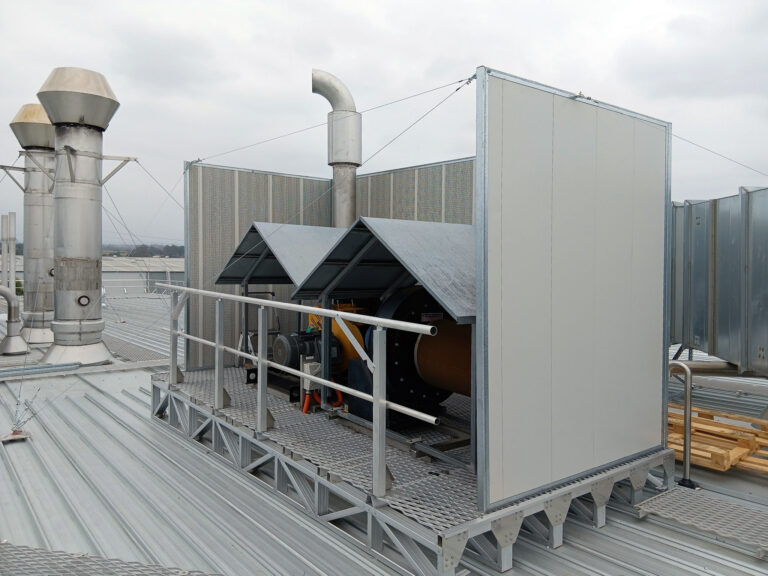
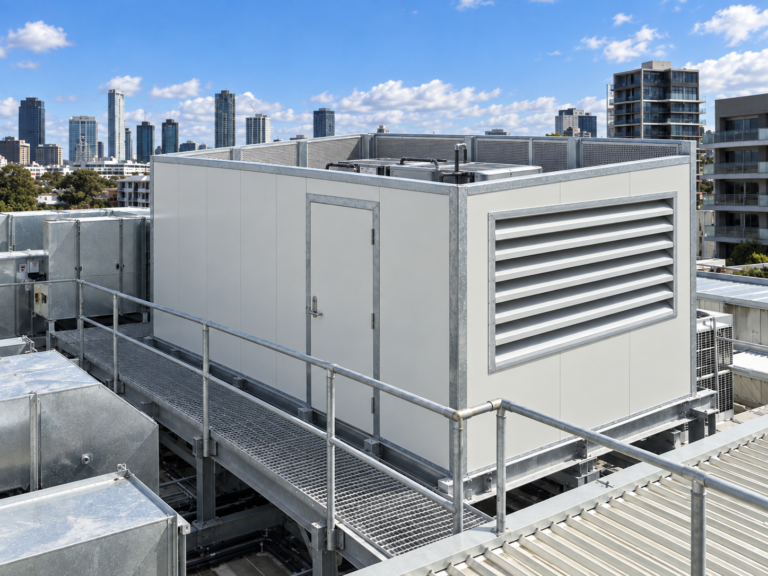
This type of construction appears in products such as AcousTech engineered partitions used in Flexshield Group installations, where mid-frequency consistency is essential for industrial environments.
Damping layers and stable performance
Damping layers convert vibration into heat and smooth the TL curve. Constrained-layer designs are a practical example. A viscoelastic core shears under vibration, reducing resonant peaks and delivering more stable performance across octave bands.
This principle underpins several AcousTech barrier assemblies, particularly where light-gauge metal would otherwise behave unpredictably under airborne loading.
Perforated liners, insulation, and IL improvements
Perforated liners work by directing air into absorptive materials. The perforation pattern, open area, and insulation type determine how much energy is dissipated inside ducts and silencers.
AcousTech liners, paired with tailored insulation density, are designed for use in Flexshield silencers and enclosure treatments. Matching density to the dominant frequency range prevents one of the most common design errors seen on industrial sites.
Flanking paths and installation quality
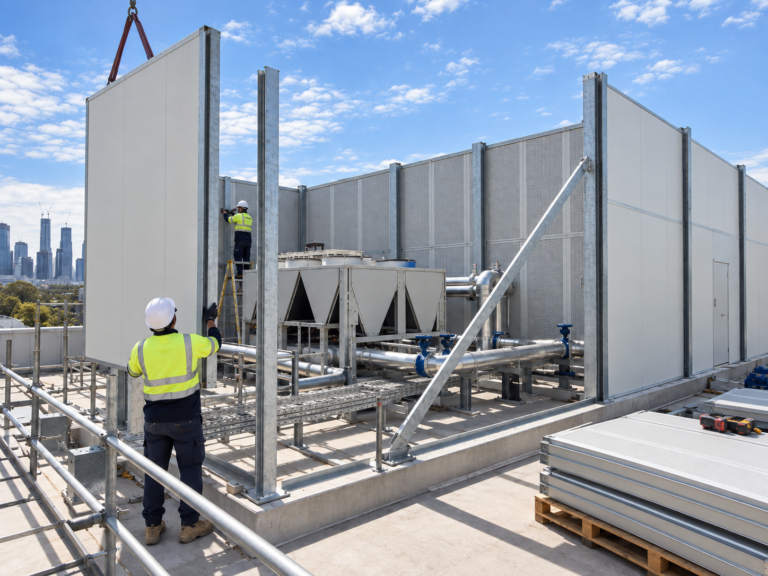
Even well-designed materials falter if energy bypasses the barrier. Small gaps, rigid fixings, and continuous steel paths can reduce NR far more than an underperforming panel. Floating mounts, sealed perimeters, and staggered joints close these pathways.
This is one of the reasons AcousTech onsite assessments focus as much on construction detail as material selection. Many NR shortfalls originate from flanking rather than product performance of particular acoustic material choices.
Common mistakes when choosing acoustic materials
Patterns we’ve observed across Flexshield Group projects include:
- Relying only on mass without managing stiffness interactions
- Using perforated liners with insulation that does not match the required frequency range
- Mounting panels too rigidly and pushing resonance into sensitive bands
- Assuming laboratory TL will be replicated in field conditions
- Underrating flanking during early design stages
Avoiding these errors requires scientific understanding supported by practical field experience. The AcousTech brand was built for this kind of work. We live inside the Science of Silence, experimenting, refining, and applying insights that shape real-world outcomes.
Get expert advice on acoustic material choices
Material selection remains one of the most powerful ways to influence IL, TL and NR. Mass, stiffness, damping, absorption, and installation detailing each play a part in determining how sound interacts with a structure. When these factors are used with intent, workplaces become clearer, safer, and more predictable.
To talk to the specialists at AcousTech, call 1300 508 232.
Trusted by engineers, built for performance.
That’s the Science of Silence.