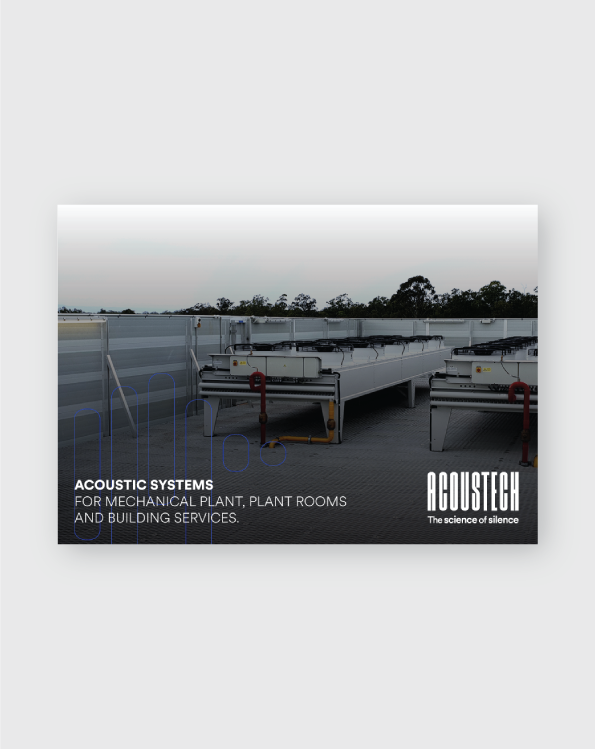
HVAC noise control for plant rooms and building services
What you will learn
- How AcousTech engineers complete HVAC noise control packages using four coordinated elements (panels, doors, louvres and attenuators) so performance on paper matches performance on site.
- Why most HVAC acoustic failures happen at interfaces rather than primary elements, including service penetrations, door frames, louvre sight lines, roof and structure-borne paths, and flanking at panel junctions.
- The role of Sonic System acoustic modular panels in containment and absorption, with Rw ratings from 31dB to 45dB, FRL -/120/-, and a non-combustible Rockwool core used for plant room walls, chiller enclosures and rooftop screens.
- How the SonicFix pre-hung frame system used with Sonic Access acoustic doors eliminates leakage at the frame junction, delivering Rw up to 52dB in single or double leaf configurations.
- The range of Sonic Series acoustic louvres across eight blade configurations from 100mm to 600mm depth, with Rw 18dB to 33dB and free area from 21% to 67%, including chevron and double-stage blades for high-performance applications.
- How Sonic acoustic attenuators in cylindrical, podded and rectangular configurations reduce duct-borne and breakout noise from HVAC ductwork, AHU connections and fan discharge without restricting airflow.
- Why early engagement at schematic design stage costs a fraction of late-stage remediation, and how coordination with mechanical and building services engineers keeps acoustic compliance embedded from the outset.
- Typical applications across data centres, commercial developments, government and public buildings, and manufacturing and industrial facilities, with sector-specific considerations for each environment.
- How NATA-accredited laboratory testing, Australian manufacturing, CAD and BIM availability, and post-installation acoustic testing give engineers and consultants the documentation they need to specify with confidence.
"(Required)" indicates required fields